How to use this calculator
Measure a time series' lag-k autocorrelation using the full-series mean and the calculator's stated descriptive normalization.
- Enter Observations, comma-separated, Lag k. Match the units shown beside each field and review the result together with the assumptions below.
- Read the worked example below to check the expected input format and result.
- Compare another scenario by changing one input at a time. Use Reset to return to the starting values.
How Autocorrelation at lag calculator works
Measure a time series' lag-k autocorrelation using the full-series mean and the calculator's stated descriptive normalization.
Inputs and units
- Observations, comma-separated: Enter finite observations in time order at equally spaced intervals.
- Lag k: Enter a whole-number lag k from 1 to less than the series length.
Formula and method
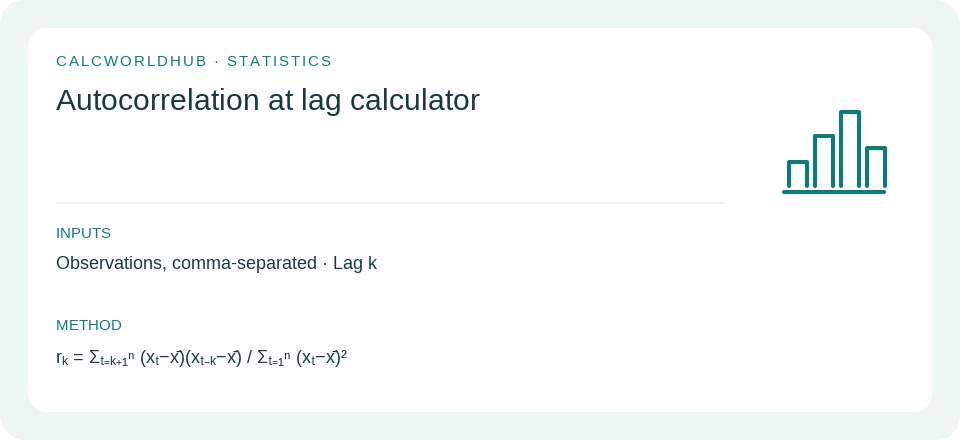
rₖ = Σₜ₌ₖ₊₁ⁿ (xₜ−x̄)(xₜ₋ₖ−x̄) / Σₜ₌₁ⁿ (xₜ−x̄)²
Worked example
For 4, 7, 7, 10, 12, the mean is 8. At lag 1, centered cross-products sum to 4+1−2+8=11; the full-series centered sum of squares is 38, so r₁=11/38≈0.2895.
Interpreting the result
Positive values indicate adjacent observations tend to be on the same side of the mean; negative values indicate opposite-side pairing under this normalization.
Assumptions and limits
Uses the full-series mean and full-series sum-of-squares denominator, so conventions may differ from software using a lag-specific denominator. Requires a nonconstant series and meaningful time ordering/equal spacing; autocorrelation is not causation.
Sources and method
- Autocorrelation compares observations separated by a lag and depends on series ordering. NIST/SEMATECH e-Handbook
Frequently asked questions
Why can another package return a slightly different autocorrelation?
Packages may use a lag-specific or full-series denominator and different mean conventions; compare the exact definition.
What does lag 1 represent?
It pairs each observation after the first with the immediately preceding observation.
How do I use the Autocorrelation at lag calculator?
Enter Observations, comma-separated, Lag k. Match the units shown beside each field and review the result together with the assumptions below.
What is a worked example of Autocorrelation at lag?
For 4, 7, 7, 10, 12, the mean is 8. At lag 1, centered cross-products sum to 4+1−2+8=11; the full-series centered sum of squares is 38, so r₁=11/38≈0.2895.
What does the Autocorrelation at lag calculator calculate?
Measure a time series' lag-k autocorrelation using the full-series mean and the calculator's stated descriptive normalization.