How to use this calculator
Estimate transformant colonies recovered per microgram of DNA from the plated fraction of a bacterial transformation.
- Enter Colonies counted, Reciprocal dilution factor, Total recovery volume (mL), Volume plated from the stated dilution (mL), then complete the remaining labeled fields. Match the units shown beside each field and review the result together with the assumptions below.
- Read the worked example below to check the expected input format and result.
- Compare another scenario by changing one input at a time. Use Reset to return to the starting values.
How this calculation works
Transformation efficiency normalizes selected transformant colonies to the amount of DNA used. When only an aliquot or a diluted aliquot is plated, the colony count must be scaled to the total recovery mixture before dividing by DNA mass.
Inputs and units
colonyCount— Colonies counted- Selectable colonies counted on the plate or combined replicate plates.
dilutionFactor— Reciprocal dilution factor- Use 1 for undiluted recovery mixture or 100 for a 1:100 dilution.
recoveryVolumeMl— Total recovery volume (mL)- Total outgrowth volume represented by the plated sample.
platedVolumeMl— Volume plated from the stated dilution (mL)- Aliquot volume placed on the plate at the entered dilution.
dnaMassNg— DNA added to transformation (ng)- Total DNA mass added to the transformation reaction.
Formula
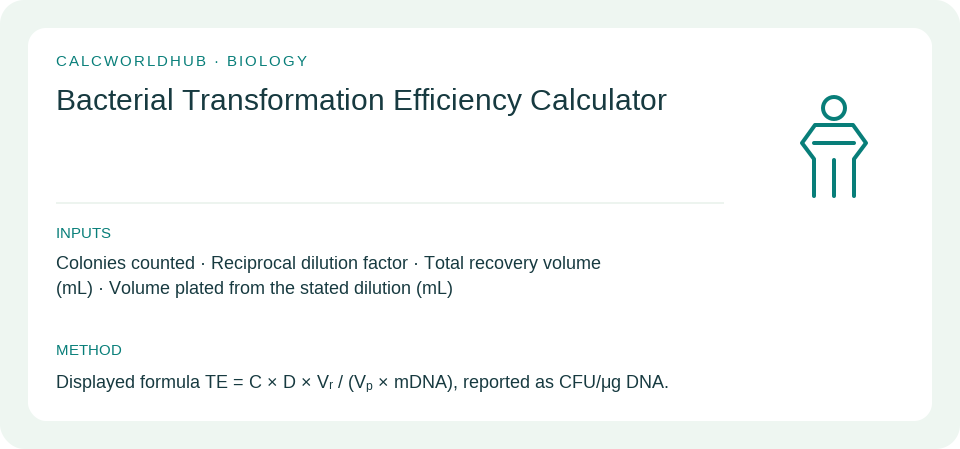
TE = C × D × Vᵣ / (Vₚ × mDNA), reported as CFU/μg DNA.
Method
Enter colonies counted, reciprocal dilution factor, total recovery volume, plated volume, and DNA mass added. The calculator scales the counted colonies by the fraction of the recovery mixture represented on the plate, then normalizes by DNA mass converted from nanograms to micrograms.
Worked example
If 100 colonies come from 0.10 mL plated at a 1:10 dilution of a 1.00 mL recovery, the estimate is 10,000 CFU; with 10 ng DNA, TE = 1.00 × 10⁶ CFU/μg.
Assumptions and limits
This estimate assumes colonies arise from the sampled transformation mixture and that the dilution and plated-volume records are correct. It measures recoverable selectable colonies under the chosen protocol; it does not correct for ligation efficiency, cell viability, plating losses, or multiple plasmids entering one cell.
Frequently asked questions
Why scale for plated volume and dilution?
The plate represents only a fraction of the recovery mixture, so its colony count is scaled to the total before normalization.
What does CFU/μg DNA mean?
It is the number of recoverable selectable transformant colonies estimated per microgram of DNA added.
Can I compare different competent-cell protocols directly?
Use the same DNA form, selection, recovery, dilution, and plating conventions; protocol differences can change the measured efficiency.
How do I use the Bacterial Transformation Efficiency Calculator?
Enter Colonies counted, Reciprocal dilution factor, Total recovery volume (mL), Volume plated from the stated dilution (mL), then complete the remaining labeled fields. Match the units shown beside each field and review the result together with the assumptions below.
What is a worked example of Bacterial Transformation Efficiency?
If 100 colonies come from 0.10 mL plated at a 1:10 dilution of a 1.00 mL recovery, the estimate is 10,000 CFU; with 10 ng DNA, TE = 1.00 × 10⁶ CFU/μg.
Reference: Addgene bacterial transformation, recovery, and plating protocol. See our calculation methodology.