How to use this calculator
Estimate culturable microorganisms per gram from colonies, dilution, plated volume, and a prepared solid-sample homogenate.
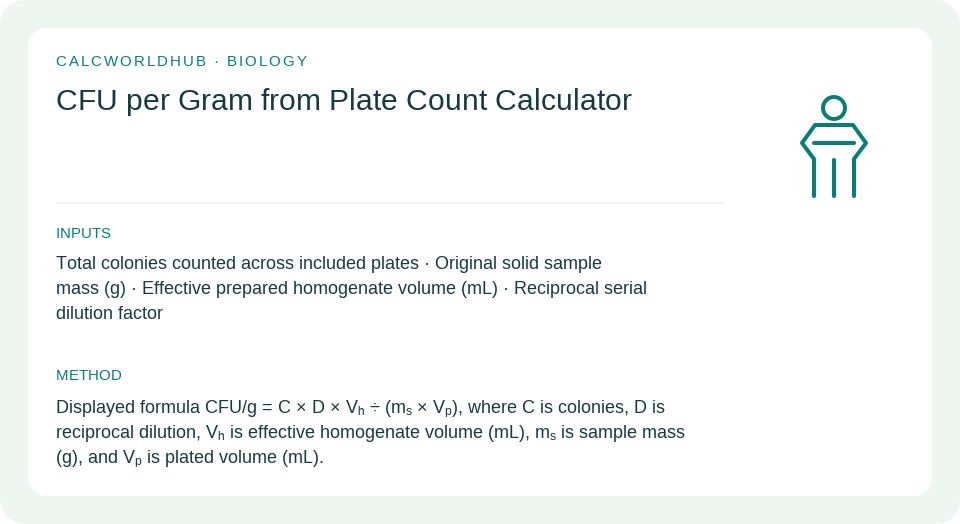
- Enter Total colonies counted across included plates, Original solid sample mass (g), Effective prepared homogenate volume (mL), Reciprocal serial dilution factor, then complete the remaining labeled fields. Match the units shown beside each field and review the result together with the assumptions below.
- Read the worked example below to check the expected input format and result.
- Compare another scenario by changing one input at a time. Use Reset to return to the starting values.
How this calculation works
For a solid sample, a plate count must be related back to the amount of original material represented in the plated aliquot. This estimate tracks sample mass, effective homogenate volume, serial dilution, and total plated volume so the result is reported as colony-forming units per gram rather than per millilitre.
Inputs and units
colonies— Total colonies counted across included plates- Enter the sum from replicate plates prepared at the same serial dilution. A zero count returns zero, not a detection-limit estimate.
sampleMassG— Original solid sample mass (g)- Mass of the original solid sample represented by the prepared homogenate.
homogenateVolumeMl— Effective prepared homogenate volume (mL)- Use the volume basis representing sample concentration; for example, a nominal 1:10 homogenate from 25 g is often treated as 250 mL.
dilutionFactor— Reciprocal serial dilution factor- Enter 1 for the primary homogenate, 100 for 10⁻², or 1,000 for 10⁻³.
platedVolumeMl— Total plated volume at that dilution (mL)- For replicate plates from the same dilution, add their plated volumes together.
Formula
CFU/g = C × D × Vₕ ÷ (mₛ × Vₚ), where C is colonies, D is reciprocal dilution, Vₕ is effective homogenate volume (mL), mₛ is sample mass (g), and Vₚ is plated volume (mL).
Method
The plated aliquot represents (sample mass ÷ homogenate volume) × (plated volume ÷ dilution factor) grams of original sample. Divide colonies by that represented mass. Enter a reciprocal dilution such as 1,000 for a 10⁻³ dilution. For replicate plates at one dilution, enter summed colonies and summed plated volume.
Worked example
A 25 g sample is prepared as 250 mL effective homogenate. If 45 colonies are counted from 0.1 mL plated at 10⁻³, the estimate is 45 × 1,000 × 250 ÷ (25 × 0.1) = 4,500,000 CFU/g.
Assumptions and limits
This is a single-dilution arithmetic estimate. It assumes a homogeneous suspension, a known effective homogenate volume, and plates from one dilution. Official methods may require countable ranges, multiple dilutions, weighted-plate rules, or organism-specific methods. This tool does not validate a microbiological method or establish food safety.
Frequently asked questions
What factor should I enter for a 10⁻³ plate?
Enter 1,000 because the input asks for the reciprocal dilution factor.
Can I combine replicate plates?
Yes, when they use the same dilution and method: add colony counts and plated volumes before entering them.
Does zero colonies mean zero organisms?
No. Zero is the arithmetic result for the entered aliquot; it is not a detection-limit or absence claim.
Is this an official food-safety result?
No. Use the applicable validated method and reporting rules for regulatory or safety decisions.
How do I use the CFU per Gram from Plate Count Calculator?
Enter Total colonies counted across included plates, Original solid sample mass (g), Effective prepared homogenate volume (mL), Reciprocal serial dilution factor, then complete the remaining labeled fields. Match the units shown beside each field and review the result together with the assumptions below.
Reference: FDA Bacteriological Analytical Manual Chapter 3 on aerobic plate counts and dilution-based enumeration. See our calculation methodology.