How to use this calculator
Estimate ideal cusp height between parallel ball-nose finishing passes from cutter diameter and lateral stepover.
- Enter Ball-nose cutter diameter (mm), Lateral stepover (mm). Match the units shown beside each field and review the result together with the assumptions below.
- Read the worked example below to check the expected input format and result.
- Compare another scenario by changing one input at a time. Use Reset to return to the starting values.
How this calculation works
This geometric estimate describes the ridge left between neighboring ball-nose cutter paths on an ideal flat surface. It provides a theoretical finish-planning value, not a prediction of measured roughness.
Inputs and units
diameterMm— Ball-nose cutter diameter (mm)- Enter the full diameter of the spherical cutting end.
stepoverMm— Lateral stepover (mm)- Distance between adjacent parallel toolpaths; use the same length unit as the diameter.
Formula
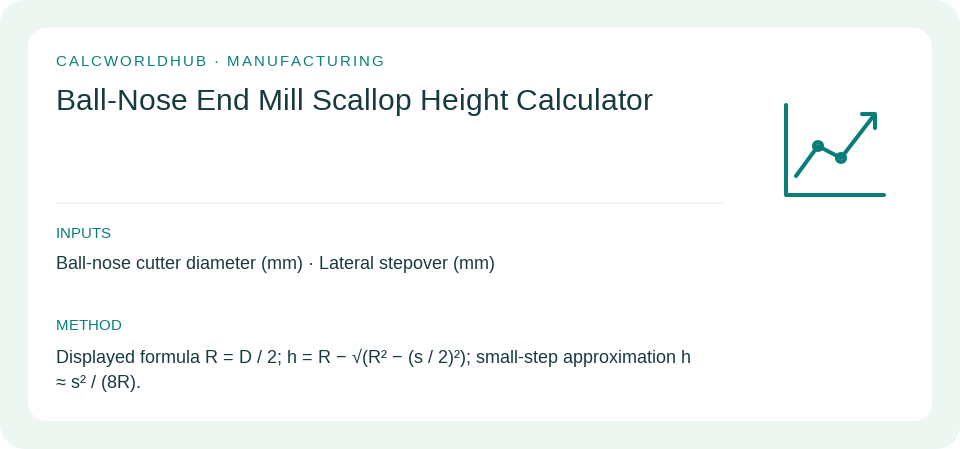
R = D / 2; h = R − √(R² − (s / 2)²); small-step approximation h ≈ s² / (8R).
Method
Enter the full ball diameter and lateral stepover in the same units. The calculator evaluates the exact circular geometry and also reports the small-step approximation for comparison.
Worked example
For a 10 mm diameter ball-nose cutter and a 0.5 mm stepover, R = 5 mm and the exact ideal cusp is 5 − √(25 − 0.0625) ≈ 0.006254 mm.
Assumptions and limits
Assumes an ideal full ball-nose profile, parallel passes, and a flat surface. It excludes surface curvature, runout, tool wear, deflection, vibration, material effects, and machine motion. Scallop height is not Ra.
Frequently asked questions
What does scallop height represent?
It is the ideal peak-to-valley cusp between adjacent ball-nose passes on a flat surface.
Is scallop height the same as Ra?
No. Ra is measured surface roughness; toolpath scallop geometry alone cannot predict it.
What units should I use?
Enter diameter and stepover in the same units. This form labels the inputs in millimeters.
How do I use the Ball-Nose End Mill Scallop Height Calculator?
Enter Ball-nose cutter diameter (mm), Lateral stepover (mm). Match the units shown beside each field and review the result together with the assumptions below.
What is a worked example of Ball-Nose End Mill Scallop Height?
For a 10 mm diameter ball-nose cutter and a 0.5 mm stepover, R = 5 mm and the exact ideal cusp is 5 − √(25 − 0.0625) ≈ 0.006254 mm.
Reference: CutterBest ball-nose stepover guide deriving ideal scallop height from spherical cutter geometry. See our calculation methodology.