How to use this calculator
Estimate payload mass capacity from displaced-air density, lifting-gas density, balloon volume, and envelope mass.
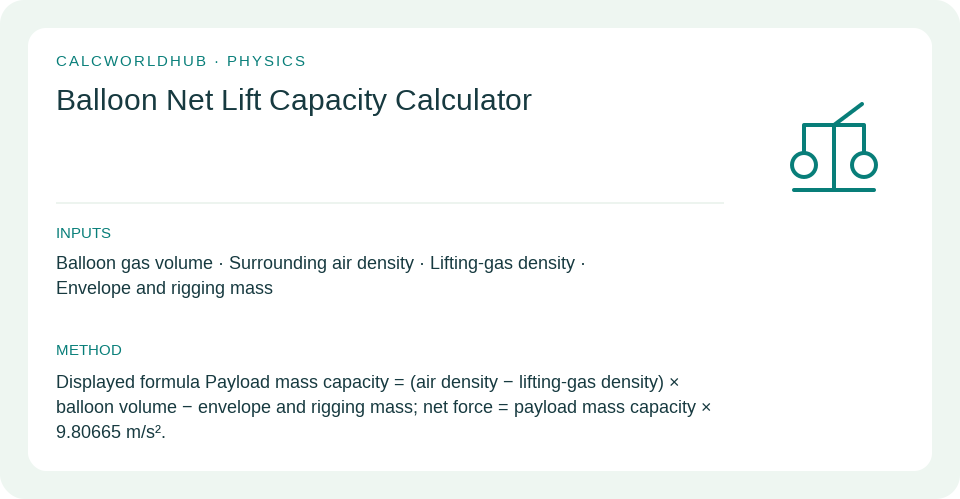
- Enter Balloon gas volume, Surrounding air density, Lifting-gas density, Envelope and rigging mass. Match the units shown beside each field and review the result together with the assumptions below.
- Read the worked example below to check the expected input format and result.
- Compare another scenario by changing one input at a time. Use Reset to return to the starting values.
How this calculation works
A lifting balloon must displace surrounding air while carrying the lifting gas, envelope, rigging, and payload. This calculator starts from measured or modeled air and gas densities at the same conditions, then subtracts the entered envelope and rigging mass to estimate the remaining payload margin.
Inputs and units
volume— Balloon gas volume- Inflated balloon volume in cubic metres.
airDensity— Surrounding air density- Air density in kg/m³ at the same operating conditions used for gas density.
gasDensity— Lifting-gas density- Density of the gas inside the balloon in kg/m³ at the same conditions.
hardwareMass— Envelope and rigging mass- Balloon skin, tether, and other hardware mass in kilograms; do not include payload.
Formula
Payload mass capacity = (air density − lifting-gas density) × balloon volume − envelope and rigging mass; net force = payload mass capacity × 9.80665 m/s².
Method
The density difference gives the mass of air displaced minus the mass of lifting gas. Subtract balloon hardware mass to obtain the mass still available for payload. Multiplication by standard gravitational acceleration expresses that mass margin as force; a negative result means the assumed system does not have positive payload capacity.
Worked example
At 1.225 kg/m³ air density and 0.1786 kg/m³ helium density, a 2.5 m³ balloon has 2.616 kg of displaced-air-minus-gas mass. After subtracting 0.45 kg of envelope and rigging, estimated payload capacity is 2.166 kg, or about 21.24 N.
Assumptions and limits
Use air and gas densities at the same pressure and temperature and a volume appropriate to the balloon’s operating state. The calculation ignores envelope stretch, tethers, leaks, temperature gradients, altitude changes, and dynamic loads, so it is a static estimate rather than a launch design.
Frequently asked questions
Why must the two densities use matching conditions?
The gas and surrounding air are compared at the same pressure and temperature; mismatched conditions distort the buoyancy balance.
What does a negative payload capacity mean?
It means the entered gas volume cannot support the entered envelope and rigging mass under the stated densities, even before adding payload.
Does this predict how many small party balloons I need?
No. This version estimates one balloon from its measured volume and densities. Small balloon shells, strings, leakage, and gas purity can materially change lift.
How do I use the Balloon Net Lift Capacity Calculator?
Enter Balloon gas volume, Surrounding air density, Lifting-gas density, Envelope and rigging mass. Match the units shown beside each field and review the result together with the assumptions below.
What is a worked example of Balloon Net Lift Capacity?
At 1.225 kg/m³ air density and 0.1786 kg/m³ helium density, a 2.5 m³ balloon has 2.616 kg of displaced-air-minus-gas mass. After subtracting 0.45 kg of envelope and rigging, estimated payload capacity is 2.166 kg, or about 21.24 N.
Reference: NASA Scientific Balloon Program buoyancy and system-mass explanation. See our calculation methodology.