How to use this calculator
Measure operating expense relative to a bank’s net interest income plus noninterest income for a matching reporting period.
- Enter Noninterest expense ($), Net interest income ($), Noninterest income ($). Match the units shown beside each field and review the result together with the assumptions below.
- Read the worked example below to check the expected input format and result.
- Compare another scenario by changing one input at a time. Use Reset to return to the starting values.
How this calculation works
A bank efficiency ratio compares noninterest operating expense with the revenue base formed by net interest income and noninterest income. Lower values indicate less expense per unit of this defined revenue base, but the ratio alone does not measure earnings quality or risk.
Inputs and units
noninterestExpense— Noninterest expense ($)- Operating expense excluding interest expense, for the reporting period.
netInterestIncome— Net interest income ($)- Interest income minus interest expense for the same period.
noninterestIncome— Noninterest income ($)- Fee and other noninterest income included in the selected ratio definition.
Formula
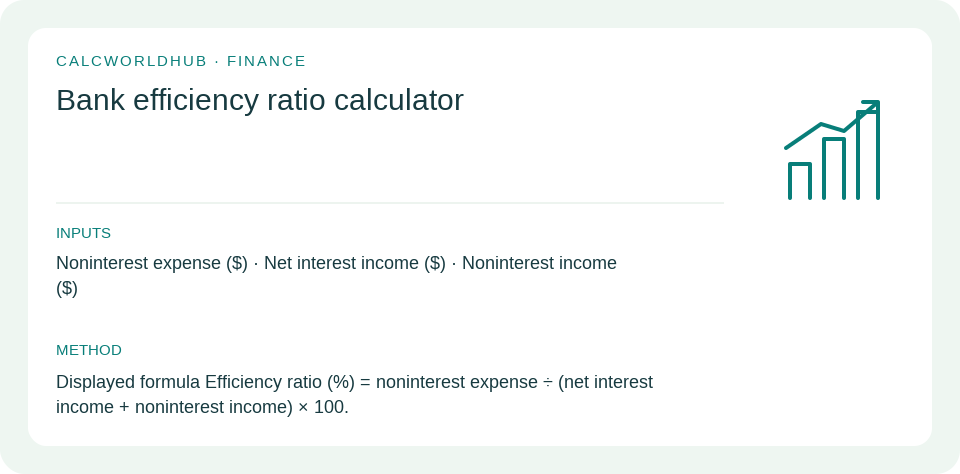
Efficiency ratio (%) = noninterest expense ÷ (net interest income + noninterest income) × 100.
Method
Enter noninterest expense, net interest income, and noninterest income for the same reporting interval and accounting scope. This version uses the entered figures directly and does not apply tax-equivalent adjustments or remove one-time items.
Worked example
If net interest income is $900,000, noninterest income is $340,000, and noninterest expense is $620,000, the ratio is $620,000 ÷ $1,240,000 × 100 = 50%.
Assumptions and limits
Financial institutions may define or adjust the ratio differently, including tax-equivalent interest income, excluded amortization, or one-time expenses. The result is only comparable when the inputs use the same conventions.
Frequently asked questions
Does a lower efficiency ratio always mean a healthier bank?
No. It describes expense relative to a defined revenue base and does not show credit risk, capital, liquidity, or revenue sustainability.
Should interest expense be included in noninterest expense?
No. Use noninterest expense in the numerator and net interest income in the denominator.
Why might a reported ratio differ from this result?
An institution may use tax-equivalent net interest income, exclude selected expenses, or adjust unusual items.
How do I use the Bank efficiency ratio calculator?
Enter Noninterest expense ($), Net interest income ($), Noninterest income ($). Match the units shown beside each field and review the result together with the assumptions below.
What is a worked example of Bank efficiency ratio?
If net interest income is $900,000, noninterest income is $340,000, and noninterest expense is $620,000, the ratio is $620,000 ÷ $1,240,000 × 100 = 50%.
Reference: SEC-reported bank efficiency ratio definition. See our calculation methodology.