How to use this calculator
Compare a bank’s loan balance with its deposit base as a percentage using figures from the same scope and date.
- Enter Total loans ($), Total deposits ($). Match the units shown beside each field and review the result together with the assumptions below.
- Read the worked example below to check the expected input format and result.
- Compare another scenario by changing one input at a time. Use Reset to return to the starting values.
How this calculation works
The loan-to-deposit ratio compares loans with deposits and is often used as a descriptive balance-sheet measure. This calculator reports the ratio and the simple difference between the two entered balances; it does not interpret whether the result is prudent for a particular institution.
Inputs and units
totalLoans— Total loans ($)- Loan balance for the selected bank and reporting scope.
totalDeposits— Total deposits ($)- Deposit balance for the same entity, scope, and reporting date.
Formula
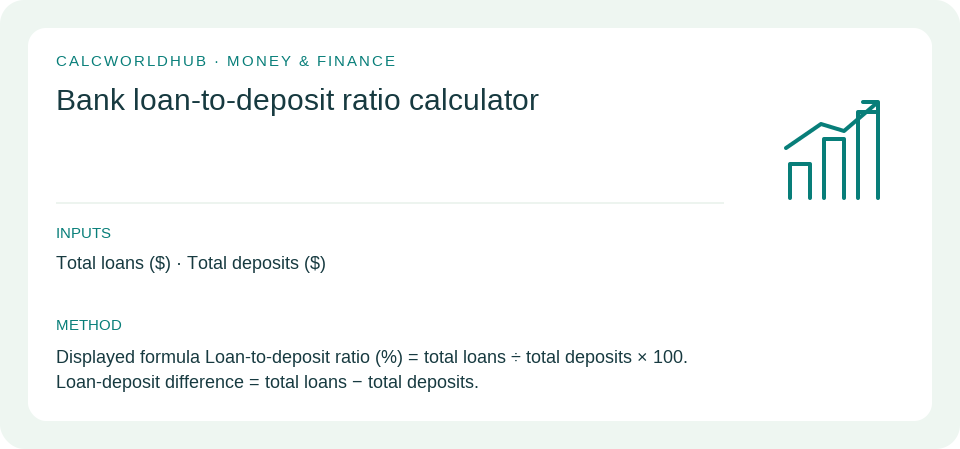
Loan-to-deposit ratio (%) = total loans ÷ total deposits × 100. Loan-deposit difference = total loans − total deposits.
Method
Enter loan and deposit balances for the same institution, geography, reporting date, and currency. Keep the chosen loan definition consistent across comparisons, such as gross loans or a specific regulatory measure.
Worked example
With $800 million in loans and $1 billion in deposits, the loan-to-deposit ratio is 800 ÷ 1,000 × 100 = 80%. Loans are $200 million below deposits in this simplified comparison.
Assumptions and limits
This ratio alone does not measure liquidity, asset quality, capital adequacy, funding stability, or regulatory compliance. Definitions and reporting scopes can vary; use the applicable reporting instructions when preparing a regulatory or investor analysis.
Frequently asked questions
How is the loan-to-deposit ratio calculated?
Divide the loan balance by the deposit balance for the same scope and multiply by 100.
Does a high ratio automatically mean a bank is unsafe?
No. The ratio is only one balance-sheet measure; it does not account for deposit stability, liquidity assets, funding sources, or credit quality.
Should I use gross or net loans?
Use the definition required by your analysis or reporting source and apply it consistently when comparing periods or institutions.
How do I use the Bank loan-to-deposit ratio calculator?
Enter Total loans ($), Total deposits ($). Match the units shown beside each field and review the result together with the assumptions below.
What is a worked example of Bank loan-to-deposit ratio?
With $800 million in loans and $1 billion in deposits, the loan-to-deposit ratio is 800 ÷ 1,000 × 100 = 80%. Loans are $200 million below deposits in this simplified comparison.
Reference: OCC loan-to-deposit ratio definition. See our calculation methodology.