How to use this calculator
Annualize net loan charge-offs against average loans to compare a bank portfolio’s realized credit losses over a reporting period.
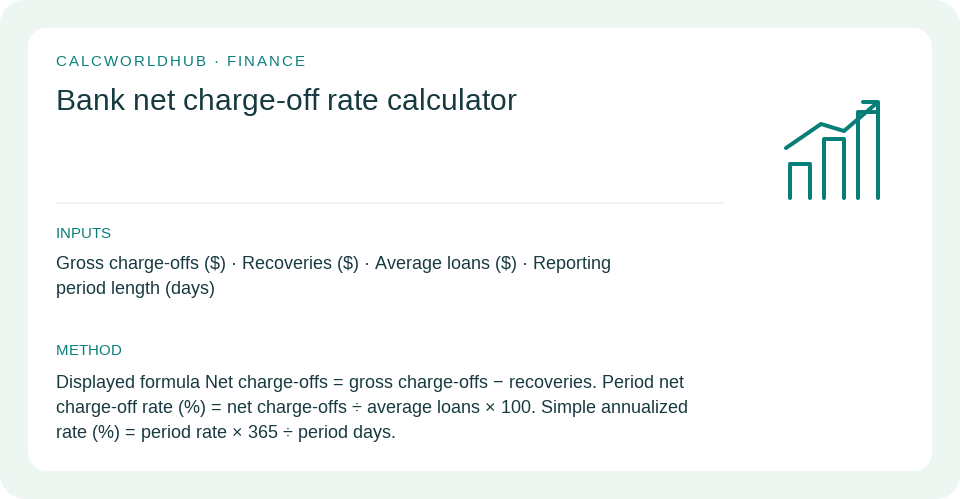
- Enter Gross charge-offs ($), Recoveries ($), Average loans ($), Reporting period length (days). Match the units shown beside each field and review the result together with the assumptions below.
- Read the worked example below to check the expected input format and result.
- Compare another scenario by changing one input at a time. Use Reset to return to the starting values.
How this calculation works
Net charge-offs are loans written off, less recoveries recorded during the period. Relating that net amount to average loans puts loss dollars on a common portfolio-size basis. The annualized rate scales a partial-period observation to a year; it does not predict future losses.
Inputs and units
chargeOffs— Gross charge-offs ($)- Loan principal charged off during the reporting period.
recoveries— Recoveries ($)- Recoveries on previously charged-off loans during the same period.
averageLoans— Average loans ($)- Average loan balance over the matching reporting interval.
periodDays— Reporting period length (days)- Calendar days covered by the charge-off and average-loan figures.
Formula
Net charge-offs = gross charge-offs − recoveries. Period net charge-off rate (%) = net charge-offs ÷ average loans × 100. Simple annualized rate (%) = period rate × 365 ÷ period days.
Method
Use charge-offs, recoveries, average loans, and the reporting-period length from the same portfolio and accounting scope. Annualization uses a simple 365-day factor, so for a 90-day quarter it scales the period rate by 365/90.
Worked example
With $180,000 in gross charge-offs, $30,000 in recoveries, and $100 million in average loans over 90 days, net charge-offs are $150,000. The period rate is 0.15%; simple annualization gives 0.15% × 365 ÷ 90 = 0.6083%.
Assumptions and limits
Charge-off timing, portfolio mix, recoveries, and accounting definitions affect comparisons. A simple day-count annualization may differ from a regulator’s or institution’s reporting convention. A realized loss ratio is not a forecast of credit losses.
Frequently asked questions
What counts as a net charge-off?
Subtract recoveries recorded in the same period from gross charge-offs, using the reporting source’s definitions.
Why annualize a quarterly rate?
Annualization makes the period ratio easier to compare with a full-year rate, but it assumes the observed pace continues mechanically.
Can the net charge-off rate be negative?
Yes. If recoveries exceed current-period charge-offs, net charge-offs and the calculated rate are negative for that interval.
How do I use the Bank net charge-off rate calculator?
Enter Gross charge-offs ($), Recoveries ($), Average loans ($), Reporting period length (days). Match the units shown beside each field and review the result together with the assumptions below.
What is a worked example of Bank net charge-off rate?
With $180,000 in gross charge-offs, $30,000 in recoveries, and $100 million in average loans over 90 days, net charge-offs are $150,000. The period rate is 0.15%; simple annualization gives 0.15% × 365 ÷ 90 = 0.6083%.
Reference: FDIC Quarterly Banking Profile reporting on net charge-off rates. See our calculation methodology.