How to use this calculator
Estimate radial primary-consolidation progress in the ideal influence cell around a vertical drain.
- Enter Horizontal consolidation coefficient (m²/day), Equivalent influence diameter (m), Equivalent drain diameter (m), Elapsed drainage time (days). Match the units shown beside each field and review the result together with the assumptions below.
- Read the worked example below to check the expected input format and result.
- Compare another scenario by changing one input at a time. Use Reset to return to the starting values.
Barron equal strain vertical drain radial consolidation explained
How the calculation works
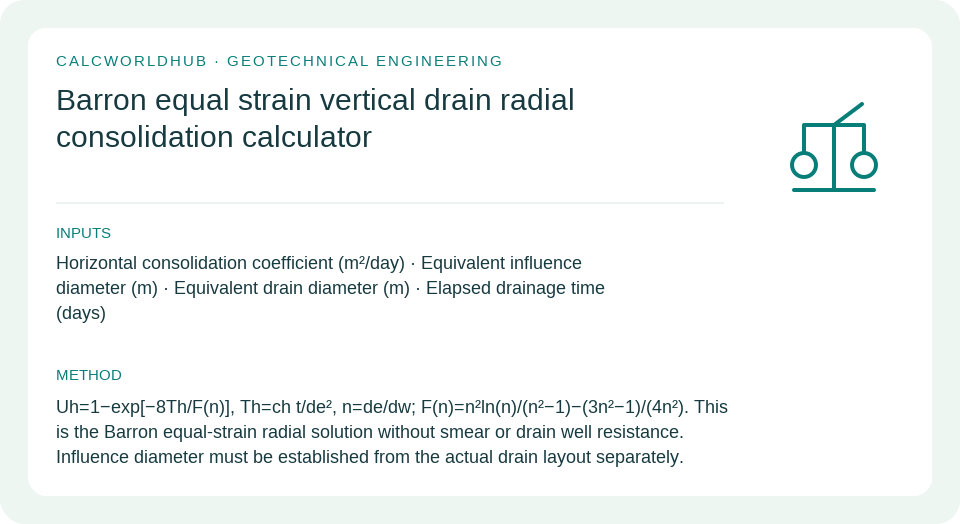
Uh=1−exp[−8Th/F(n)], Th=ch t/de², n=de/dw; F(n)=n²ln(n)/(n²−1)−(3n²−1)/(4n²).
This is the Barron equal-strain radial solution without smear or drain well resistance. Influence diameter must be established from the actual drain layout separately.
Set up the calculation
ch— Horizontal consolidation coefficient (m²/day)- Radial consolidation coefficient for the simplified equal-strain model.
de— Equivalent influence diameter (m)- Diameter of the circular influence cell assigned to one vertical drain.
dw— Equivalent drain diameter (m)- Circular-equivalent drain diameter based on the selected perimeter convention.
t— Elapsed drainage time (days)- Time after an ideal instantaneous uniform load.
Limits of this model
Perfect drain boundary, constant horizontal coefficient, no smear or finite discharge resistance, and uniform instantaneous loading. Educational model; this is not a code-compliant design check.
Check this example
Horizontal consolidation coefficient (m²/day) = 0.05; Equivalent influence diameter (m) = 1.5; Equivalent drain diameter (m) = 0.08; Elapsed drainage time (days) = 60.
- Average radial consolidation: 99.232688 %
- Radial time factor: 1.333333
- Geometry function F(n): 2.190266
An influence diameter 1.5 m, equivalent drain diameter 0.08 m, ch=0.05 m²/day and 60 days give n=18.75 and radial time factor 1.3333.
Reading the outputs
Radial consolidation is percent; Th and the geometry function are dimensionless. It is not the combined vertical-plus-radial degree.
Frequently asked questions
Is ch interchangeable with vertical cv?
Not necessarily. Soil permeability and compressibility anisotropy can make horizontal and vertical coefficients differ.
Does this include smear around installed drains?
No. Smear and finite drain resistance generally slow consolidation and require additional terms.
Can Uh simply be added to Uv?
No. Under the usual independence idealization the combined degree is 1−(1−Uh)(1−Uv), not their sum.
How do I use the Barron equal strain vertical drain radial consolidation calculator?
Enter Horizontal consolidation coefficient (m²/day), Equivalent influence diameter (m), Equivalent drain diameter (m), Elapsed drainage time (days). Match the units shown beside each field and review the result together with the assumptions below.
What is a worked example of Barron equal strain vertical drain radial consolidation?
Horizontal consolidation coefficient (m²/day) = 0.05; Equivalent influence diameter (m) = 1.5; Equivalent drain diameter (m) = 0.08; Elapsed drainage time (days) = 60. Average radial consolidation: 99.232688 % Radial time factor: 1.333333 Geometry function F(n): 2.190266 An influence diameter 1.5 m, equivalent drain diameter 0.08 m, ch=0.05 m²/day and 60 days give n=18.75 and radial time factor 1.3333.
Method reference: FHWA NHI-16-027 Ground Modification Methods Reference Manual, Volume I. The manual summarizes Barron’s radial-drain solution for vertical drains; this page retains the ideal equal-strain model and excludes smear and drain resistance.
Background or definition reference: USACE EM 1110-1-1904, Settlement Analysis.
Read our calculation methodology.