Bernoulli variance calculator
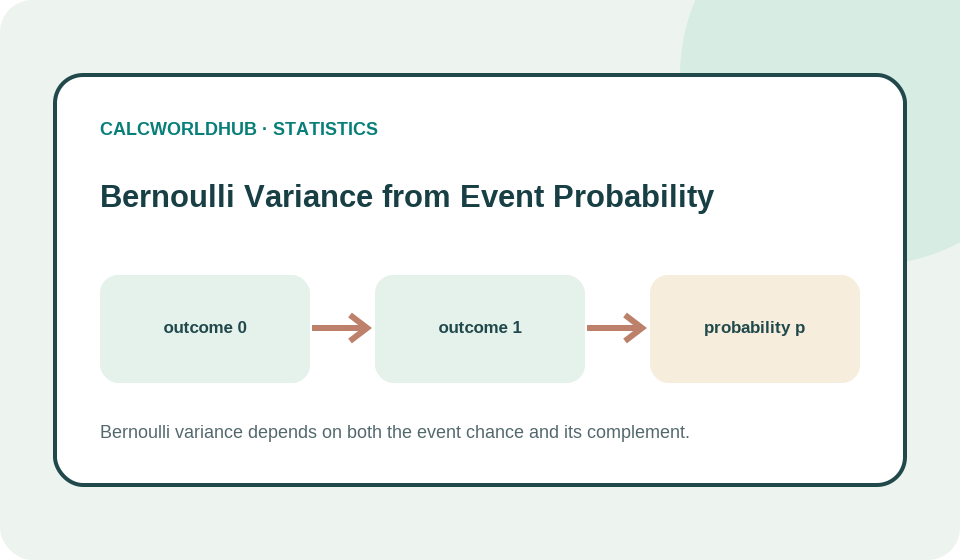
Compute the variance of a zero-one Bernoulli outcome from its decimal success probability.
How to use this calculator
Compute the variance of a zero-one Bernoulli outcome from its decimal success probability.
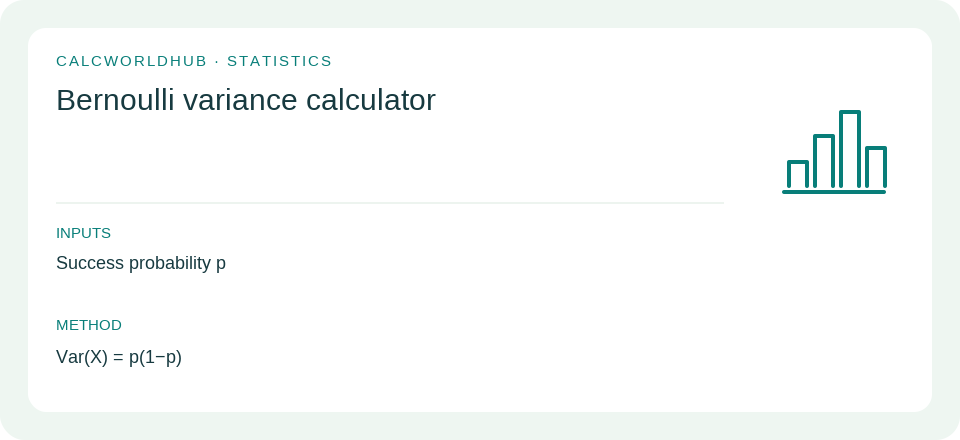
- Enter Success probability p. Match the units shown beside each field and review the result together with the assumptions below.
- Read the worked example below to check the expected input format and result.
- Compare another scenario by changing one input at a time. Use Reset to return to the starting values.
How the Bernoulli variance calculator works
Compute the variance of a zero-one Bernoulli outcome from its decimal success probability.
Inputs and units
- Success probability p: Decimal probability of a success; enter 0.5 for 50%.
Formula and method
Var(X) = p(1−p)
Worked example
At p=0.5, variance is 0.5×0.5=0.25. At p=0 or p=1, the outcome is certain and variance is zero.
Interpreting the result
Variance is greatest at p=0.5. It describes a single zero-one trial, not the variance of a sample proportion.
Assumptions and limits
Probability must be between zero and one. For n independent trials, count variance is np(1−p); proportion variance is p(1−p)/n.
Sources and method
- Defines a zero-one random variable with success probability p. SciPy: Bernoulli distribution
Frequently asked questions
Does p=0.5 mean the variance is 25%?
The variance is 0.25 in squared zero-one units; it is not a success percentage.
How do I get standard deviation?
Take √[p(1−p)]; at p=0.5 it is 0.5.
How do I use the Bernoulli variance calculator?
Enter Success probability p. Match the units shown beside each field and review the result together with the assumptions below.
What is a worked example of Bernoulli variance?
At p=0.5, variance is 0.5×0.5=0.25. At p=0 or p=1, the outcome is certain and variance is zero.
What does the Bernoulli variance calculator calculate?
Compute the variance of a zero-one Bernoulli outcome from its decimal success probability.
See the calculation methodology.