How to use this calculator
Generate the exact output sequence of a small feed-forward binary convolutional encoder using explicit tap and bit-order conventions.
- Enter Message as unsigned integer, Message width (bits), Constraint length (bits), Generator masks as unsigned integers, then complete the remaining labeled fields. Match the units shown beside each field and review the result together with the assumptions below.
- Read the worked example below to check the expected input format and result.
- Compare another scenario by changing one input at a time. Use Reset to return to the starting values.
Binary convolutional encoder output word explained
The encoder reads the chosen message width most-significant bit first, shifts each input through the constraint-length register, and emits one parity bit per generator mask. Optional zero-tail termination appends constraint-length minus one zeros to return the memory state to zero.
Inputs, symbols, and units
message— Message as unsigned integer- Message bits are transmitted MSB first with explicit message width below. Enter a whole number.
bits— Message width (bits)- Retain this many leading and significant message bits. Enter a whole number.
constraint— Constraint length (bits)- Current input bit plus stored input memory. Enter a whole number.
generators— Generator masks as unsigned integers- Full binary taps; mask bit zero multiplies the newest input, bit one the previous input. Use comma-separated values in the stated order.
terminate— Append zero-tail termination- Append constraint-minus-one zeros to return the zero-initialized memory to zero. Choose yes, no.
Formula and method
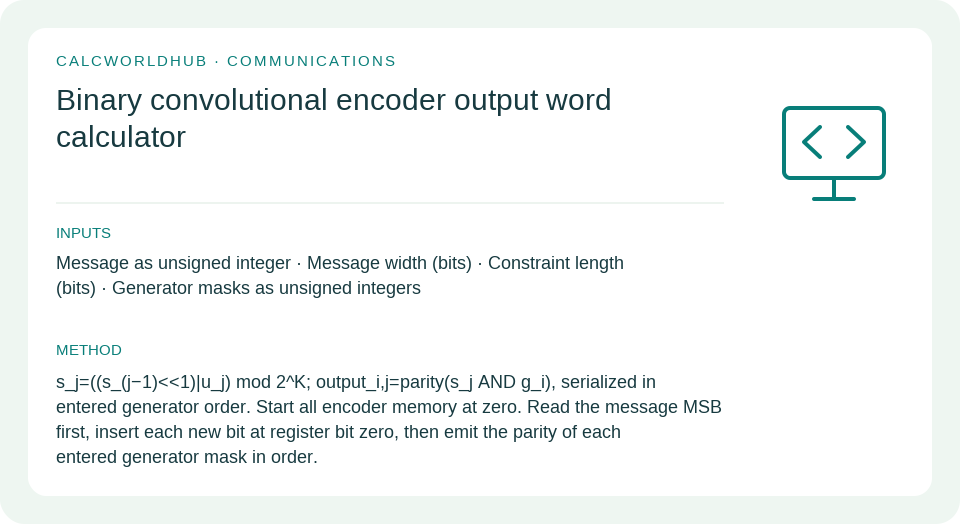
s_j=((s_(j−1)<<1)|u_j) mod 2^K; output_i,j=parity(s_j AND g_i), serialized in entered generator order.
Start all encoder memory at zero. Read the message MSB first, insert each new bit at register bit zero, then emit the parity of each entered generator mask in order.
A worked scenario
Message as unsigned integer = 45; Message width (bits) = 6; Constraint length (bits) = 3; Generator masks as unsigned integers = 7,5; Append zero-tail termination = yes.
- Encoded output word: 57675 unsigned integer
- Encoded Hamming weight: 8 one bits
- Encoded output width: 16 bits
Message 45 with width six is binary 101101. Constraint length three and generator masks 7 and 5 use taps 111 and 101; zero-tail termination appends two zero inputs.
Assumptions and edge cases
Feed-forward binary encoding only, at most 52 coded bits; no recursive feedback, puncturing, trellis decoding or proof that supplied generators are noncatastrophic.
Reading the outputs
Output word is an exact unsigned integer; its bit-width metric tells how many leading zero bits to retain. Hamming weight counts transmitted one bits.
Frequently asked questions
Are generator masks decimal or octal?
Enter unsigned decimal integers representing the binary tap masks; no automatic octal interpretation is used.
Why append zero inputs?
For this feed-forward shift-register convention, K−1 zeros flush all previous input bits from memory.
Can this decode noisy codewords?
No; decoding requires a trellis algorithm and a channel metric, which are separate tasks.
How do I use the Binary convolutional encoder output word calculator?
Enter Message as unsigned integer, Message width (bits), Constraint length (bits), Generator masks as unsigned integers, then complete the remaining labeled fields. Match the units shown beside each field and review the result together with the assumptions below.
What is a worked example of Binary convolutional encoder output word?
Message as unsigned integer = 45; Message width (bits) = 6; Constraint length (bits) = 3; Generator masks as unsigned integers = 7,5; Append zero-tail termination = yes. Encoded output word: 57675 unsigned integer Encoded Hamming weight: 8 one bits Encoded output width: 16 bits Message 45 with width six is binary 101101. Constraint length three and generator masks 7 and 5 use taps 111 and 101; zero-tail termination appends two zero inputs.
Background or definition reference: MIT digital communication error-correcting codes.
Read our calculation methodology.