How to use this calculator
Perform educational modulo-two polynomial division and append the zero-initialized CRC remainder to a binary message.
- Enter Message bits as unsigned integer, Generator polynomial bits as integer. Match the units shown beside each field and review the result together with the assumptions below.
- Read the worked example below to check the expected input format and result.
- Compare another scenario by changing one input at a time. Use Reset to return to the starting values.
Binary polynomial CRC remainder and codeword explained
Divide the message polynomial shifted by the CRC width by its generator over GF(2) to obtain the remainder and codeword.
A numerical walkthrough
Message bits as unsigned integer = 53; Generator polynomial bits as integer = 19.
- CRC remainder: 0 unsigned integer
- Appended CRC codeword: 848 unsigned integer
- CRC width: 4 bits
Message integer 53 is binary 110101. Generator 19 is binary 10011, so the four-bit remainder is appended after four zero placeholders.
The model behind the numbers
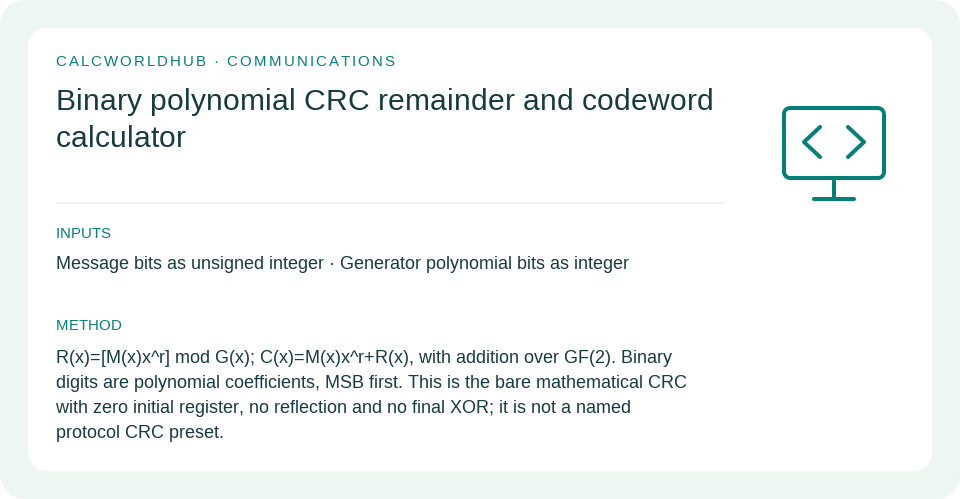
R(x)=[M(x)x^r] mod G(x); C(x)=M(x)x^r+R(x), with addition over GF(2).
Binary digits are polynomial coefficients, MSB first. This is the bare mathematical CRC with zero initial register, no reflection and no final XOR; it is not a named protocol CRC preset.
What to enter
message— Message bits as unsigned integer- Integer whose binary digits are the message, MSB first. Enter a whole number.
generator— Generator polynomial bits as integer- Full polynomial including its leading and constant one bits; 19 represents x^4+x+1. Enter a whole number.
Interpreting the result
Up to 24-bit message/generator inputs and at most 52 output bits; no protocol initialization, bit reflection, byte ordering or final complement.
Reading the outputs
Remainder and codeword are shown as exact unsigned integers; CRC width indicates how many binary positions must be retained, including leading zeros.
Frequently asked questions
Why might a protocol CRC disagree?
Protocols specify initialization, reflection, final XOR and byte order in addition to the generator polynomial.
Does the leading generator bit need entering?
Yes; the full polynomial is required here, including its top-degree coefficient.
Do leading zero remainder bits matter?
Yes; retain the reported CRC width even when the numeric remainder is small.
How do I use the Binary polynomial CRC remainder and codeword calculator?
Enter Message bits as unsigned integer, Generator polynomial bits as integer. Match the units shown beside each field and review the result together with the assumptions below.
What is a worked example of Binary polynomial CRC remainder and codeword?
Message bits as unsigned integer = 53; Generator polynomial bits as integer = 19. CRC remainder: 0 unsigned integer Appended CRC codeword: 848 unsigned integer CRC width: 4 bits Message integer 53 is binary 110101. Generator 19 is binary 10011, so the four-bit remainder is appended after four zero placeholders.
Background or definition reference: RFC 3385 CRC polynomial arithmetic.
Read our calculation methodology.