How to use this calculator
Trade interleaver depth against the worst number of burst-damaged symbols delivered to one protected codeword.
- Enter Interleaver depth (codewords), Symbols per codeword, Contiguous transmitted burst (symbols), Channel symbol rate (symbol/s). Match the units shown beside each field and review the result together with the assumptions below.
- Read the worked example below to check the expected input format and result.
- Compare another scenario by changing one input at a time. Use Reset to return to the starting values.
Block-interleaver burst spreading explained
Use Interleaver depth (codewords) with Symbols per codeword to reproduce the sample calculation, then review the stated limits before carrying the result into another scenario.
A numerical walkthrough
Interleaver depth (codewords) = 8; Symbols per codeword = 255; Contiguous transmitted burst (symbols) = 40; Channel symbol rate (symbol/s) = 100000.
- Maximum errors in one codeword: 5 symbols
- Full-block serialization delay: 0.0204 s
- Rows receiving one extra error: 0 codewords
A 40-symbol burst across depth eight spreads at most five errors to each word; 8 by 255 symbols at 100 ksymbol/s also introduces block buffering time.
The model behind the numbers
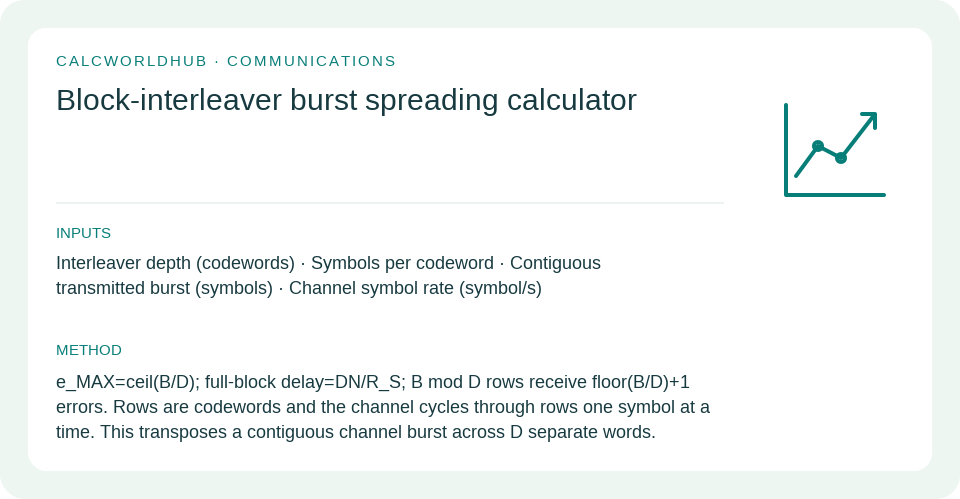
e_MAX=ceil(B/D); full-block delay=DN/R_S; B mod D rows receive floor(B/D)+1 errors.
Rows are codewords and the channel cycles through rows one symbol at a time. This transposes a contiguous channel burst across D separate words.
What to enter
depth— Interleaver depth (codewords)- Number of rows/codewords across which consecutive transmitted symbols cycle. Enter a whole number.
length— Symbols per codeword- Number of columns in the rectangular interleaver. Enter a whole number.
burst— Contiguous transmitted burst (symbols)- Number of adjacent corrupted channel symbols in one block. Enter a whole number.
symbolRate— Channel symbol rate (symbol/s)- Rate at which the interleaver serializes symbols.
Interpreting the result
One rectangular block, one contained burst and cyclic row transmission; convolutional interleavers and burst wrapping need another mapping.
Reading the outputs
Serialization delay is a full-block upper bookkeeping interval, not an exact end-to-end streaming latency for every possible implementation.
Frequently asked questions
Must a burst begin at the first row?
No; ceil(B/D) is the worst row count for any starting row within a contained block.
Does interleaving correct errors itself?
No; it redistributes them so a separate decoder can use its correction capability.
Why does deeper interleaving add latency?
More codewords must be buffered or spread across the channel before deinterleaving completes.
How do I use the Block-interleaver burst spreading calculator?
Enter Interleaver depth (codewords), Symbols per codeword, Contiguous transmitted burst (symbols), Channel symbol rate (symbol/s). Match the units shown beside each field and review the result together with the assumptions below.
What is a worked example of Block-interleaver burst spreading?
Interleaver depth (codewords) = 8; Symbols per codeword = 255; Contiguous transmitted burst (symbols) = 40; Channel symbol rate (symbol/s) = 100000. Maximum errors in one codeword: 5 symbols Full-block serialization delay: 0.0204 s Rows receiving one extra error: 0 codewords A 40-symbol burst across depth eight spreads at most five errors to each word; 8 by 255 symbols at 100 ksymbol/s also introduces block buffering time.
Read our calculation methodology.