How to use this calculator
Estimate residue amount and average distillate composition for differential binary batch distillation.
- Enter Initial liquid amount (mol), Initial more-volatile liquid mole fraction, Final residue more-volatile mole fraction, Constant relative volatility. Match the units shown beside each field and review the result together with the assumptions below.
- Read the worked example below to check the expected input format and result.
- Compare another scenario by changing one input at a time. Use Reset to return to the starting values.
Binary Rayleigh batch distillation explained
For a binary liquid with constant relative volatility, the Rayleigh balance estimates the residue left as the more volatile component is depleted. It also uses the component balance to report the average distillate composition, which differs from the instantaneous vapor composition at the end of the batch.
Inputs, symbols, and units
f— Initial liquid amount (mol)- Initial liquid amount (mol).
x0— Initial more-volatile liquid mole fraction- Initial more-volatile liquid mole fraction.
xw— Final residue more-volatile mole fraction- Final residue more-volatile mole fraction.
a— Constant relative volatility- Constant relative volatility.
Formula and method
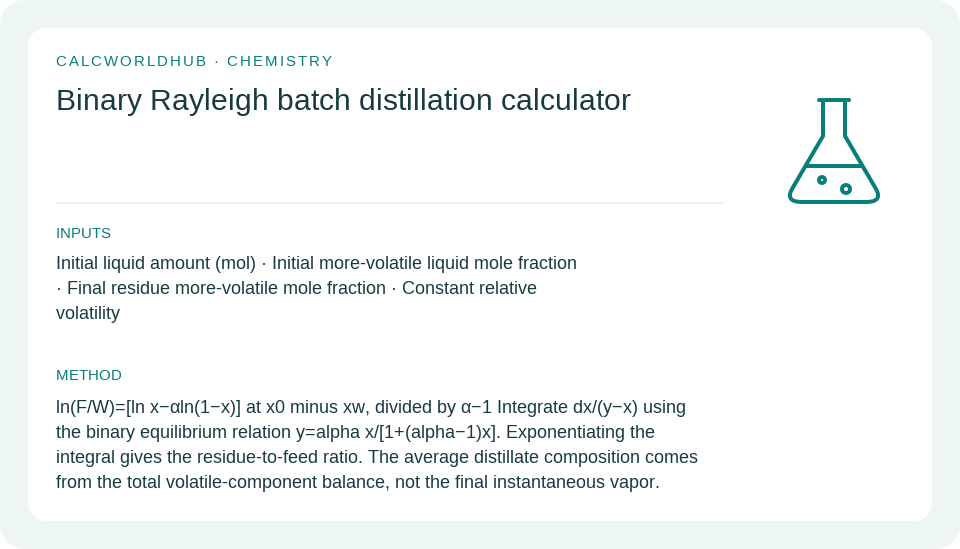
ln(F/W)=[ln x−αln(1−x)] at x0 minus xw, divided by α−1
Integrate dx/(y−x) using the binary equilibrium relation y=alpha x/[1+(alpha−1)x]. Exponentiating the integral gives the residue-to-feed ratio. The average distillate composition comes from the total volatile-component balance, not the final instantaneous vapor.
A worked scenario
Initial liquid amount (mol) = 100; Initial more-volatile liquid mole fraction = 0.5; Final residue more-volatile mole fraction = 0.2; Constant relative volatility = 2.5.
- Remaining liquid residue: 24.80314144 mol
- Total distillate: 75.19685856 mol
- Average distillate volatile fraction: 0.59895284
This scenario uses the stated units and assumptions. Displayed values are rounded only after calculation.
Assumptions and edge cases
Perfectly mixed liquid, infinitesimal equilibrium vapor removal, constant relative volatility, and negligible vapor holdup; no finite-stage reflux column is modeled.
Frequently asked questions
Must the residue become less rich in the volatile component?
Yes, this operating direction requires xw<x0.
Is average distillate composition the last vapor composition?
No, it follows the overall component balance over the whole batch.
Can I model changing relative volatility?
Not with this closed-form model.
How do I use the Binary Rayleigh batch distillation calculator?
Enter Initial liquid amount (mol), Initial more-volatile liquid mole fraction, Final residue more-volatile mole fraction, Constant relative volatility. Match the units shown beside each field and review the result together with the assumptions below.
What is a worked example of Binary Rayleigh batch distillation?
Initial liquid amount (mol) = 100; Initial more-volatile liquid mole fraction = 0.5; Final residue more-volatile mole fraction = 0.2; Constant relative volatility = 2.5. Remaining liquid residue: 24.80314144 mol Total distillate: 75.19685856 mol Average distillate volatile fraction: 0.59895284 This scenario uses the stated units and assumptions. Displayed values are rounded only after calculation.
Read our calculation methodology.