Birthday collision probability calculator
Calculate the chance of at least one repeated value in uniform independent draws from a finite set.
How to use this calculator
Calculate the chance of at least one repeated value in uniform independent draws from a finite set.
- Enter Number of draws n, Possible values M. Match the units shown beside each field and review the result together with the assumptions below.
- Read the worked example below to check the expected input format and result.
- Compare another scenario by changing one input at a time. Use Reset to return to the starting values.
How the Birthday collision probability calculator works
Calculate the chance of at least one repeated value in uniform independent draws from a finite set.
Inputs and units
- Number of draws n: Whole number of independent draws, with replacement.
- Possible values M: Whole count of equally likely possible values.
Formula and method
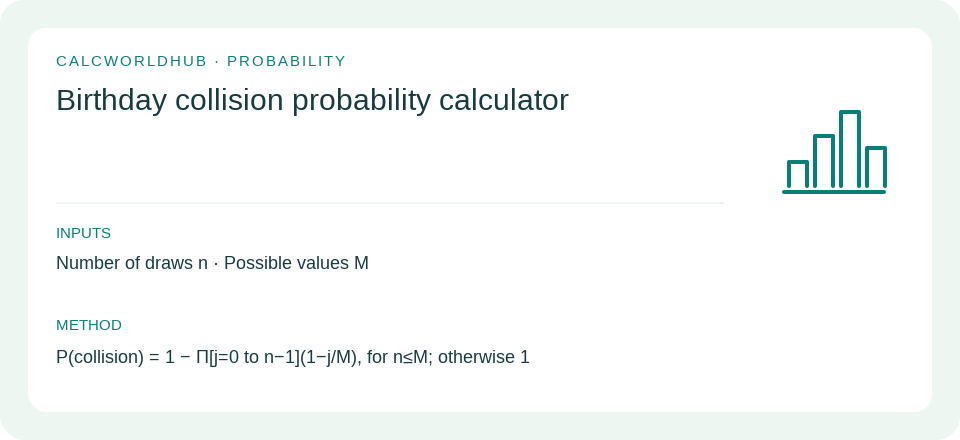
P(collision) = 1 − Π[j=0 to n−1](1−j/M), for n≤M; otherwise 1
Worked example
For 23 draws from 365 equally likely values, the product of no-collision factors is 0.4927027657, so collision probability is 0.5072972343.
Interpreting the result
A collision means any matching pair somewhere in the group, not a match with one designated person.
Assumptions and limits
n is a nonnegative whole draw count and M a positive whole number of equally likely possibilities. Calendar birthdays are not perfectly uniform; leap-day and demographic effects are omitted.
Frequently asked questions
Why is the probability above 50% with only 23 draws?
The event includes every possible pair, giving many opportunities for a repeat.
What if n exceeds M?
A repeated value is then certain by the pigeonhole principle.
How do I use the Birthday collision probability calculator?
Enter Number of draws n, Possible values M. Match the units shown beside each field and review the result together with the assumptions below.
What is a worked example of Birthday collision probability?
For 23 draws from 365 equally likely values, the product of no-collision factors is 0.4927027657, so collision probability is 0.5072972343.
What does the Birthday collision probability calculator calculate?
Calculate the chance of at least one repeated value in uniform independent draws from a finite set.
See the calculation methodology.