Blackbody peak wavelength calculator
Estimate the peak wavelength of thermal emission from a blackbody temperature. Enter your values below to see the result and method.
inputs.
Related calculators
These tools cover nearby questions while keeping this page focused on its own calculation.
How to use this calculator
Estimate the peak wavelength of thermal emission from a blackbody temperature.
- Enter Surface temperature (K). Match the units shown beside each field and review the result together with the assumptions below.
- Read the worked example below to check the expected input format and result.
- Compare another scenario by changing one input at a time. Use Reset to return to the starting values.
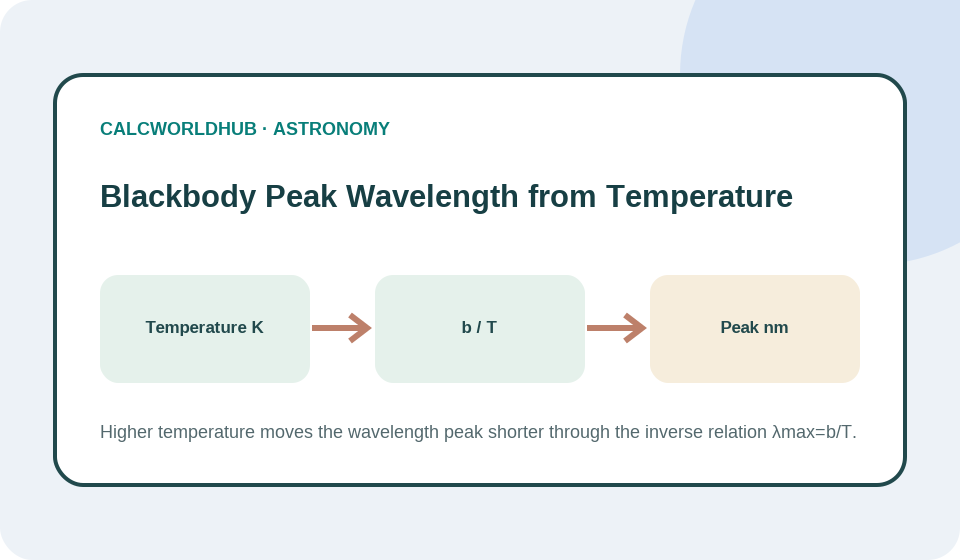
Wien’s law estimates the wavelength peak of a blackbody
This page uses a blackbody surface temperature to estimate the wavelength where spectral radiance per unit wavelength is greatest. It does not infer stellar radius, total luminosity, or the flux received at Earth.
Inputs and units
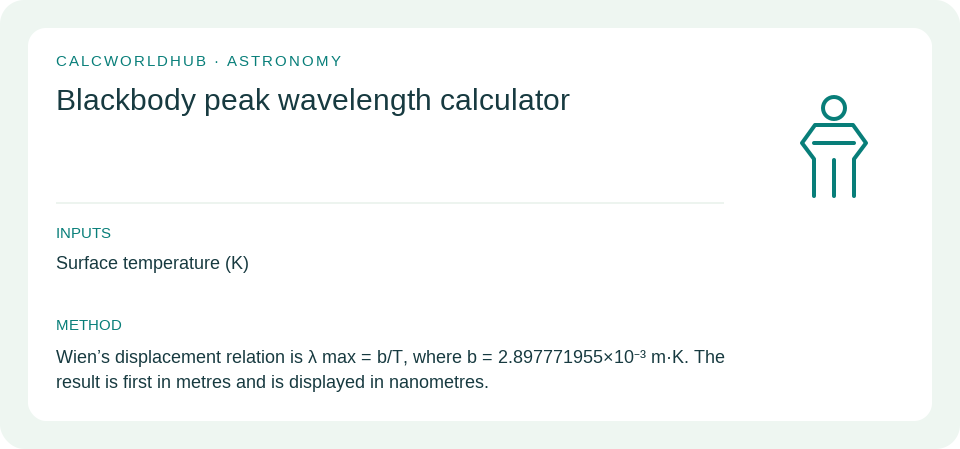
- Surface temperature (K): Enter an absolute temperature above zero in kelvins.
Formula and method
Wien’s displacement relation is λmax = b/T, where b = 2.897771955×10⁻³ m·K. The result is first in metres and is displayed in nanometres.
Worked example
For T = 5,778 K, λmax = 2.897771955×10⁻³ / 5,778 = 5.01518×10⁻⁷ m = 501.518 nm.
Interpreting the result
A lower blackbody temperature moves this wavelength peak to longer wavelengths; a higher temperature moves it shorter. “Peak” refers to the shape of the ideal blackbody spectral-radiance curve per wavelength.
Assumptions and limits
Real stars depart from ideal blackbodies because their atmospheres add wavelength-dependent absorption and emission features. This calculation does not model those features or observational uncertainty.
Frequently asked questions
What does the reported peak mean?
It is the wavelength of maximum spectral radiance per unit wavelength for an ideal blackbody at the entered temperature.
Does this predict a star’s observed brightness?
No. Brightness at a distance also depends on emitting area, distance, and the star’s actual spectrum.
Why must temperature be in kelvins?
Wien’s relation uses absolute temperature; Celsius values cannot be substituted directly.
How do I use the Blackbody peak wavelength calculator?
Enter Surface temperature (K). Match the units shown beside each field and review the result together with the assumptions below.
What is a worked example of Blackbody peak wavelength?
For T = 5,778 K, λ max = 2.897771955×10⁻³ / 5,778 = 5.01518×10⁻⁷ m = 501.518 nm .
Related calculators
- Estimate total blackbody surface flux from temperature.
- Integrate emitted power over a wavelength band.
- Relate stellar radius to luminosity and temperature.
Sources
Read the calculation methodology and privacy policy.