How to use this calculator
Estimate a weighted regular rate and overtime premium when a workweek includes two hourly pay rates.
- Enter Straight-time rate for work type 1 ($/hour), Hours at rate 1, Straight-time rate for work type 2 ($/hour), Hours at rate 2, then complete the remaining labeled fields. Match the units shown beside each field and review the result together with the assumptions below.
- Read the worked example below to check the expected input format and result.
- Compare another scenario by changing one input at a time. Use Reset to return to the starting values.
How this calculation works
When hours in one workweek are paid at different straight-time rates, the weighted average can determine the regular rate used for overtime. This estimate combines hours and pay from two work types, then computes an additional half-time premium for overtime hours.
Inputs and units
rate1— Straight-time rate for work type 1 ($/hour)- Enter the first hourly rate.
hours1— Hours at rate 1- Enter hours paid at the first straight-time rate.
rate2— Straight-time rate for work type 2 ($/hour)- Enter the second hourly rate.
hours2— Hours at rate 2- Enter hours paid at the second straight-time rate.
bonus— Included workweek bonus ($)- Enter bonus pay that should be included in the regular-rate estimate; use zero if none.
threshold— Weekly overtime threshold (hours)- Enter the overtime threshold applicable to the scenario.
Formula
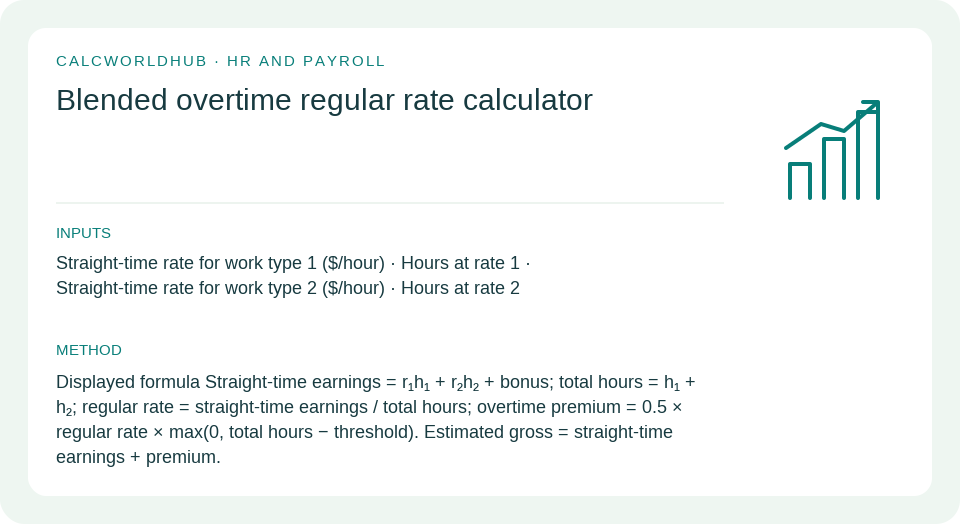
Straight-time earnings = r₁h₁ + r₂h₂ + bonus; total hours = h₁ + h₂; regular rate = straight-time earnings / total hours; overtime premium = 0.5 × regular rate × max(0, total hours − threshold). Estimated gross = straight-time earnings + premium.
Method
The model treats both rates as straight-time pay for all hours and includes the entered bonus in regular-rate earnings. It then adds a half-time premium for hours above the entered weekly threshold.
Worked example
At $20/hour for 30 hours and $30/hour for 15 hours, with a $100 included bonus, straight-time earnings are $1,150 over 45 hours. The weighted regular rate is $25.5556/hour; for a 40-hour threshold, five overtime hours add about $63.89, for modeled gross pay of about $1,213.89.
Assumptions and limits
This is a simplified U.S. FLSA estimate, not a compliance determination. Bonus exclusions, state rules, multiple workweeks, piece rates, alternative overtime agreements, and statutory exceptions can change the calculation. Verify payroll treatment with current law and qualified payroll guidance.
Frequently asked questions
Why is the rate weighted?
Each straight-time rate contributes pay in proportion to the hours worked at that rate.
Why is the premium half the regular rate?
This simplified setup assumes straight-time pay for all hours is already included; it adds the extra half-time premium for overtime hours.
Does this handle every overtime rule?
No. It simplifies one workweek with two rates. FLSA exclusions, bonuses, state rules, and special agreements can change the required payroll calculation.
How do I use the Blended overtime regular rate calculator?
Enter Straight-time rate for work type 1 ($/hour), Hours at rate 1, Straight-time rate for work type 2 ($/hour), Hours at rate 2, then complete the remaining labeled fields. Match the units shown beside each field and review the result together with the assumptions below.
What is a worked example of Blended overtime regular rate?
At $20/hour for 30 hours and $30/hour for 15 hours, with a $100 included bonus, straight-time earnings are $1,150 over 45 hours. The weighted regular rate is $25.5556/hour; for a 40-hour threshold, five overtime hours add about $63.89, for modeled gross pay of about $1,213.89.
Reference: U.S. Department of Labor FLSA overtime and weighted regular-rate guidance. See our calculation methodology.