How to use this calculator
Calculate Carlson trophic state indices separately from Secchi depth, chlorophyll-a, and total phosphorus measurements.
- Enter Secchi depth (m), Chlorophyll-a (µg/L), Total phosphorus (µg/L). Match the units shown beside each field and review the result together with the assumptions below.
- Read the worked example below to check the expected input format and result.
- Compare another scenario by changing one input at a time. Use Reset to return to the starting values.
How this calculation works
Carlson’s trophic state index (TSI) expresses three lake measurements on related index scales. Secchi transparency, chlorophyll-a, and total phosphorus each produce an independent index value.
Inputs and units
secchiM— Secchi depth (m)- Measured Secchi disk transparency in metres.
chlorophyllUgL— Chlorophyll-a (µg/L)- Chlorophyll-a concentration in micrograms per litre.
totalPhosphorusUgL— Total phosphorus (µg/L)- Total phosphorus in micrograms per litre, matching Carlson’s equation.
Formula
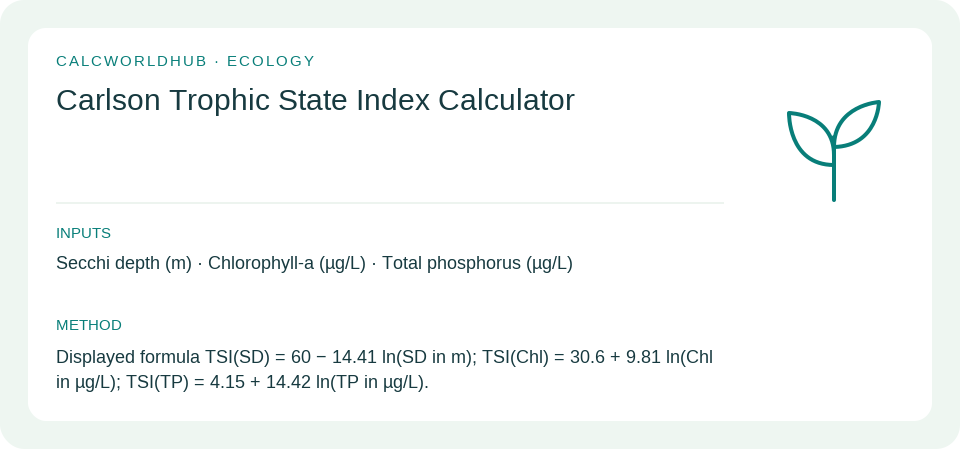
TSI(SD) = 60 − 14.41 ln(SD in m); TSI(Chl) = 30.6 + 9.81 ln(Chl in µg/L); TSI(TP) = 4.15 + 14.42 ln(TP in µg/L).
Method
Enter positive Secchi disk depth in metres, chlorophyll-a in micrograms per litre, and total phosphorus in micrograms per litre. Each measurement is transformed with its own natural-log equation; the three outputs are shown separately.
Worked example
For a Secchi depth of 2.0 m, chlorophyll-a of 10 µg/L, and total phosphorus of 25 µg/L, the indices are 50.01, 53.19, and 50.57 respectively.
Assumptions and limits
These are independent lake trophic-state indicators, not interchangeable measurements or a guaranteed single composite score. They can diverge because of non-algal turbidity, seasonal sampling, or nutrient limitation. Use comparable lake-sampling methods and the stated units.
Frequently asked questions
Why are three TSI values shown?
Carlson’s Secchi, chlorophyll-a, and phosphorus equations each provide an independent trophic-state indicator.
Can I enter phosphorus in mg/L?
Convert it to µg/L first. For example, 0.025 mg/L equals 25 µg/L.
Should I average the values?
This calculator reports the three source indices separately. Interpret their agreement or divergence using the sampling context.
How do I use the Carlson Trophic State Index Calculator?
Enter Secchi depth (m), Chlorophyll-a (µg/L), Total phosphorus (µg/L). Match the units shown beside each field and review the result together with the assumptions below.
What is a worked example of Carlson Trophic State Index?
For a Secchi depth of 2.0 m, chlorophyll-a of 10 µg/L, and total phosphorus of 25 µg/L, the indices are 50.01, 53.19, and 50.57 respectively.
Reference: U.S. EPA lake bioassessment guidance for independent Carlson trophic state indices. See our calculation methodology.