How to use this calculator
Compare a measured box compression strength with the static load from cartons stacked above a bottom carton.
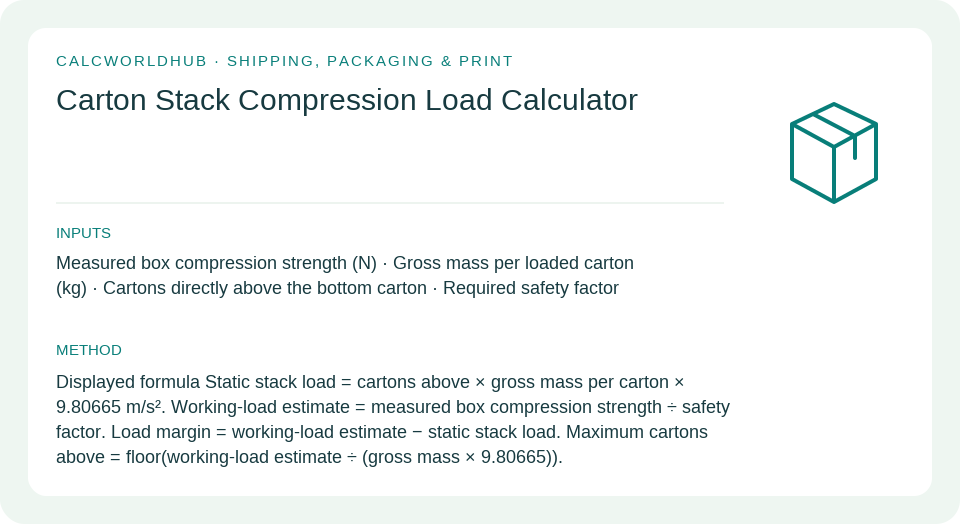
- Enter Measured box compression strength (N), Gross mass per loaded carton (kg), Cartons directly above the bottom carton, Required safety factor. Match the units shown beside each field and review the result together with the assumptions below.
- Read the worked example below to check the expected input format and result.
- Compare another scenario by changing one input at a time. Use Reset to return to the starting values.
How this calculation works
This check starts with a measured top-to-bottom compression result for the box and estimates the dead load carried by one bottom carton. Enter the number of cartons above it and a safety factor to compare a simple working-load estimate with the planned stack.
Inputs and units
testedBctN— Measured box compression strength (N)- Use a tested top-to-bottom compression result for the actual box, board, conditioning, and orientation.
cartonMassKg— Gross mass per loaded carton (kg)- Include the carton and its contents.
cartonsAbove— Cartons directly above the bottom carton- Count only the cartons whose vertical load is carried by the bottom carton in the assumed column.
safetyFactor— Required safety factor- Divide tested compression strength by this factor to define the entered working-load limit.
Formula
Static stack load = cartons above × gross mass per carton × 9.80665 m/s². Working-load estimate = measured box compression strength ÷ safety factor. Load margin = working-load estimate − static stack load. Maximum cartons above = floor(working-load estimate ÷ (gross mass × 9.80665)).
Method
The calculation assumes a vertical column of identical cartons and a static gravitational load. It uses the measured BCT you enter; it does not infer box strength from board grade or dimensions.
Worked example
With a tested box compression strength of 3,000 N, a safety factor of 3, 12 kg gross cartons, and 6 cartons above the bottom box, the static load is 6 × 12 × 9.80665 = 706.08 N. The working-load estimate is 1,000 N, leaving a 293.92 N margin; the simple column limit is 8 cartons above.
Assumptions and limits
This is a screening comparison, not a packaging qualification or ASTM test. Box performance changes with conditioning, humidity, storage duration, stacking pattern, pallet support, contents, and transport loads. Use representative testing and packaging-engineering review for design decisions.
Frequently asked questions
Where should the compression-strength input come from?
Use a test result for the actual erected box and relevant conditioning. The calculator does not predict that strength from carton dimensions.
Does the result account for humidity or long storage?
No. Those conditions can reduce stacking performance and should be reflected in testing or in the safety factor selected by the packaging engineer.
Does a positive margin certify the pallet load?
No. It checks one static column assumption only and does not assess load distribution, vibration, impact, pallet deck support, or transport qualification.
How do I use the Carton Stack Compression Load Calculator?
Enter Measured box compression strength (N), Gross mass per loaded carton (kg), Cartons directly above the bottom carton, Required safety factor. Match the units shown beside each field and review the result together with the assumptions below.
What is a worked example of Carton Stack Compression Load?
With a tested box compression strength of 3,000 N, a safety factor of 3, 12 kg gross cartons, and 6 cartons above the bottom box, the static load is 6 × 12 × 9.80665 = 706.08 N. The working-load estimate is 1,000 N, leaving a 293.92 N margin; the simple column limit is 8 cartons above.
Reference: ASTM D642 standard for measuring compressive resistance of shipping containers. See our calculation methodology.