How to use this calculator
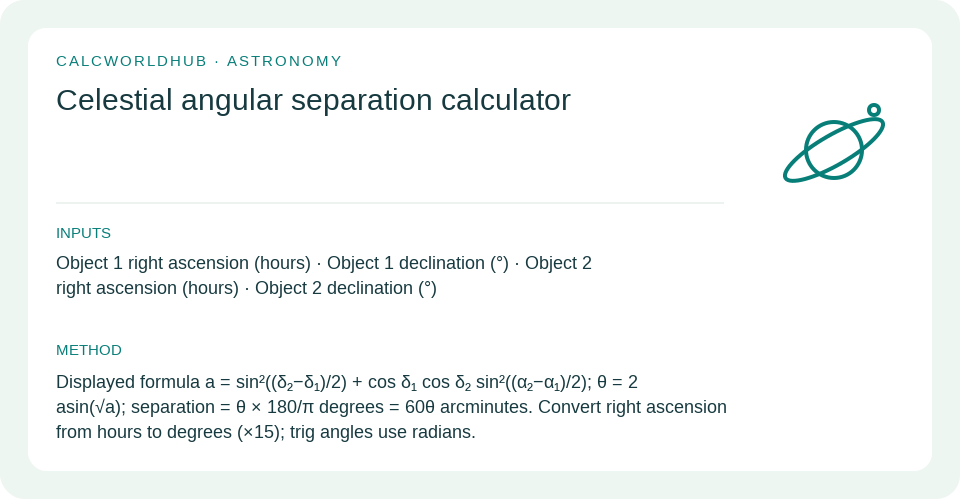
Calculate the great-circle angle between two sky positions entered as right ascension and declination.
- Enter Object 1 right ascension (hours), Object 1 declination (°), Object 2 right ascension (hours), Object 2 declination (°). Match the units shown beside each field and review the result together with the assumptions below.
- Read the worked example below to check the expected input format and result.
- Compare another scenario by changing one input at a time. Use Reset to return to the starting values.
How this calculation works
A sky catalog lists object positions as right ascension and declination, but comparing the two coordinate columns directly does not give the angular distance on the celestial sphere. Enter both positions in a common coordinate frame to estimate their great-circle separation.
Inputs and units
ra1— Object 1 right ascension (hours)- Right ascension from 0 inclusive to 24 exclusive.
dec1— Object 1 declination (°)- Declination from −90° to +90°.
ra2— Object 2 right ascension (hours)- Right ascension from 0 inclusive to 24 exclusive.
dec2— Object 2 declination (°)- Declination from −90° to +90°.
Formula
a = sin²((δ₂−δ₁)/2) + cos δ₁ cos δ₂ sin²((α₂−α₁)/2); θ = 2 asin(√a); separation = θ × 180/π degrees = 60θ arcminutes. Convert right ascension from hours to degrees (×15); trig angles use radians.
Method
The calculator converts right ascension from hours to degrees and then radians, evaluates a numerically stable haversine form of the spherical separation, and reports the angle in degrees and arcminutes. Use coordinates from the same epoch and reference frame for a meaningful comparison.
Worked example
For positions (RA, Dec) = (5 h, 20°) and (6 h, 30°), the stable spherical formula gives approximately 16.848° (about 1,010.9 arcminutes).
Assumptions and limits
This is a two-dimensional angular separation on the celestial sphere, not a physical distance. It does not precess coordinates, apply proper motion, or transform between frames; tiny differences are limited by floating-point precision.
Frequently asked questions
Why multiply right ascension by 15?
Right ascension is conventionally measured in hours; one hour corresponds to 15 degrees of angle.
Is this the straight-line distance between stars?
No. It is an angle on the celestial sphere, not a physical distance in space.
Can I compare coordinates from different epochs?
For accurate results, first place both positions in the same reference frame and epoch, accounting for proper motion where needed.
How do I use the Celestial angular separation calculator?
Enter Object 1 right ascension (hours), Object 1 declination (°), Object 2 right ascension (hours), Object 2 declination (°). Match the units shown beside each field and review the result together with the assumptions below.
What is a worked example of Celestial angular separation?
For positions (RA, Dec) = (5 h, 20°) and (6 h, 30°), the stable spherical formula gives approximately 16.848° (about 1,010.9 arcminutes).
Reference: Astropy documentation for great-circle separation of sky coordinates. See our calculation methodology.