How to use this calculator
Estimate a casting section’s solidification time from its volume, mold-contact area, and calibrated mold constant.
- Enter Casting-section volume V (mm³), Mold-contact cooling area A (mm²), Mold constant B (s/mm²). Match the units shown beside each field and review the result together with the assumptions below.
- Read the worked example below to check the expected input format and result.
- Compare another scenario by changing one input at a time. Use Reset to return to the starting values.
How this calculation works
Chvorinov's rule relates the solidification time of a casting section to its thermal modulus, the casting volume divided by the mold-contact surface area. Under the classical square-law form, sections with a larger volume-to-area ratio take longer to solidify when the metal, mold, and process conditions are comparable.
Inputs and units
volume— Casting-section volume V (mm³)- Volume of the casting section being compared.
area— Mold-contact cooling area A (mm²)- Surface area of that casting section that transfers heat to the mold.
constant— Mold constant B (s/mm²)- Calibrated Chvorinov constant for the selected metal and mold conditions, using the displayed units.
Formula
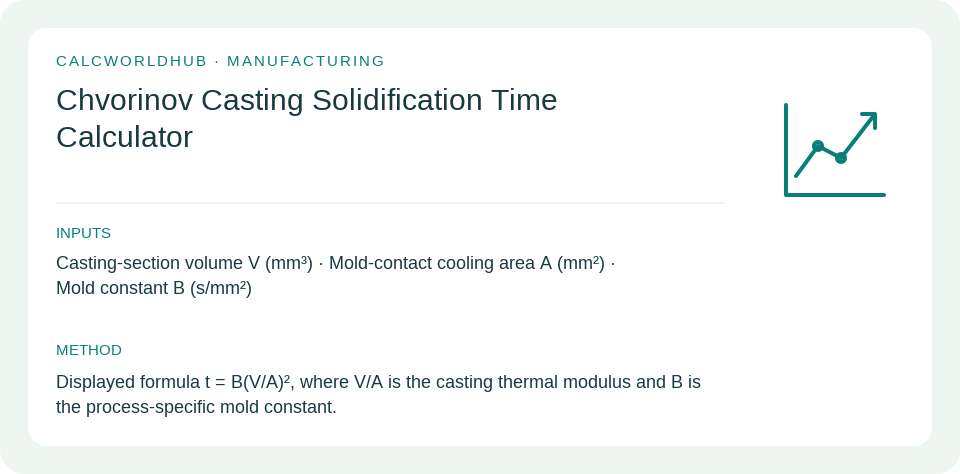
t = B(V/A)², where V/A is the casting thermal modulus and B is the process-specific mold constant.
Method
Divide the casting volume in mm³ by its mold-contact area in mm² to obtain a modulus in millimeters. Square that modulus and multiply by B in seconds per mm².
Worked example
For V = 1,000,000 mm³, A = 10,000 mm², and B = 0.010 s/mm², the modulus is 100 mm and the estimated solidification time is 100 s (1.667 min).
Assumptions and limits
The mold constant must be calibrated or selected for comparable metal, mold material, initial temperatures, interface conditions, and process. This empirical square-law estimate does not model local temperature fields, riser feeding, alloy freezing range, or complex transient heat transfer.
Frequently asked questions
How should I choose B?
Use a value calibrated for the same metal, mold material, and process conditions; B is not a universal material constant.
Why does the volume-to-area ratio matter?
The thermal modulus captures the amount of metal relative to the cooling surface. In the square-law model, doubling the modulus multiplies solidification time by four.
Does this predict the temperature of every region?
No. It estimates a section-level solidification time and does not solve a spatial or transient temperature field.
How do I use the Chvorinov Casting Solidification Time Calculator?
Enter Casting-section volume V (mm³), Mold-contact cooling area A (mm²), Mold constant B (s/mm²). Match the units shown beside each field and review the result together with the assumptions below.
What is a worked example of Chvorinov Casting Solidification Time?
For V = 1,000,000 mm³, A = 10,000 mm², and B = 0.010 s/mm², the modulus is 100 mm and the estimated solidification time is 100 s (1.667 min).
Reference: Peer-reviewed Chvorinov casting solidification-time study. See our calculation methodology.