How to use this calculator
Convert ground coffee and brew-water masses to a water-to-coffee ratio, then scale the water for a target ratio.
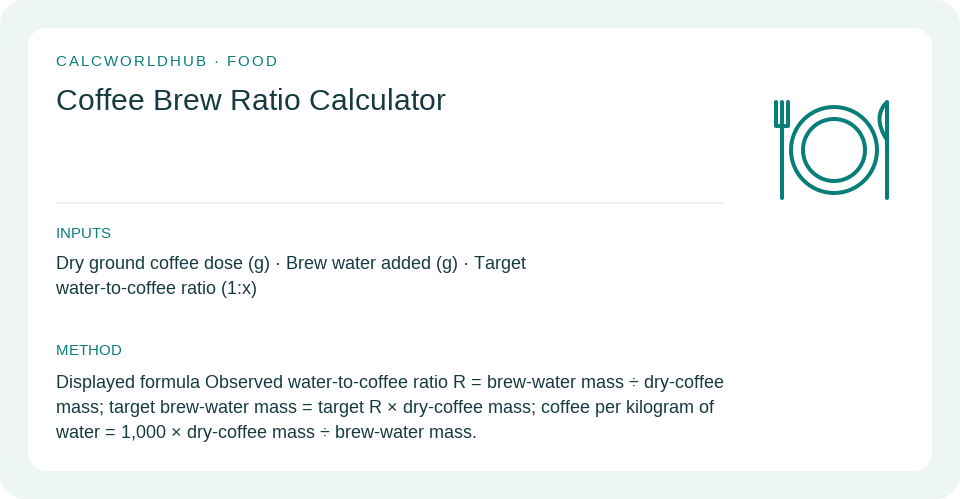
- Enter Dry ground coffee dose (g), Brew water added (g), Target water-to-coffee ratio (1:x). Match the units shown beside each field and review the result together with the assumptions below.
- Read the worked example below to check the expected input format and result.
- Compare another scenario by changing one input at a time. Use Reset to return to the starting values.
How this calculation works
A brewing ratio compares the water added to a drip or immersion brew with the mass of dry ground coffee. It is useful for scaling a recipe by weight. The calculator also reports the matching coffee mass per kilogram of water; it does not use the finished beverage mass, which defines a different beverage ratio.
Inputs and units
coffeeDose— Dry ground coffee dose (g)- Mass of dry coffee grounds before brewing, in grams.
brewWater— Brew water added (g)- Mass of water poured into the brewer, not the final beverage mass.
targetRatio— Target water-to-coffee ratio (1:x)- Enter how many grams of water to use per gram of dry coffee.
Formula
Observed water-to-coffee ratio R = brew-water mass ÷ dry-coffee mass; target brew-water mass = target R × dry-coffee mass; coffee per kilogram of water = 1,000 × dry-coffee mass ÷ brew-water mass.
Method
Both masses must use the same unit. The ratio is displayed as 1:R, meaning one mass unit of coffee for R mass units of water. The target result scales only the water amount; it does not declare a preferred taste or extraction target.
Worked example
With 30 g of dry coffee and 500 g of brew water, the observed ratio is 500 ÷ 30 = 16.67, or 1:16.67. At a chosen target of 1:16.7, the water mass for the same dose is 30 × 16.7 = 501 g.
Assumptions and limits
Uses water poured into the brewer and dry coffee dose. It does not estimate water retained by grounds, beverage yield, dissolved-solids concentration, extraction yield, or espresso beverage ratio. Those require additional measurements and different definitions.
Frequently asked questions
Does the ratio use brew water or the drink in the cup?
This tool uses the water added to the brewer. A beverage ratio instead divides the finished drink mass by the dry coffee dose.
Can I use milliliters of water?
For ordinary water, grams and milliliters are close enough for a kitchen estimate, but this calculator expects mass in grams so the ratio stays explicit.
Does a larger ratio mean stronger coffee?
The ratio describes recipe proportions, not a measured strength. Grind, time, temperature, water, and extraction affect the drink too.
How do I use the Coffee Brew Ratio Calculator?
Enter Dry ground coffee dose (g), Brew water added (g), Target water-to-coffee ratio (1:x). Match the units shown beside each field and review the result together with the assumptions below.
What is a worked example of Coffee Brew Ratio?
With 30 g of dry coffee and 500 g of brew water, the observed ratio is 500 ÷ 30 = 16.67, or 1:16.67. At a chosen target of 1:16.7, the water mass for the same dose is 30 × 16.7 = 501 g.
Reference: Specialty Coffee Association explanation distinguishing brewing ratio from beverage ratio. See our calculation methodology.