Filter coffee brew water mass budget calculator
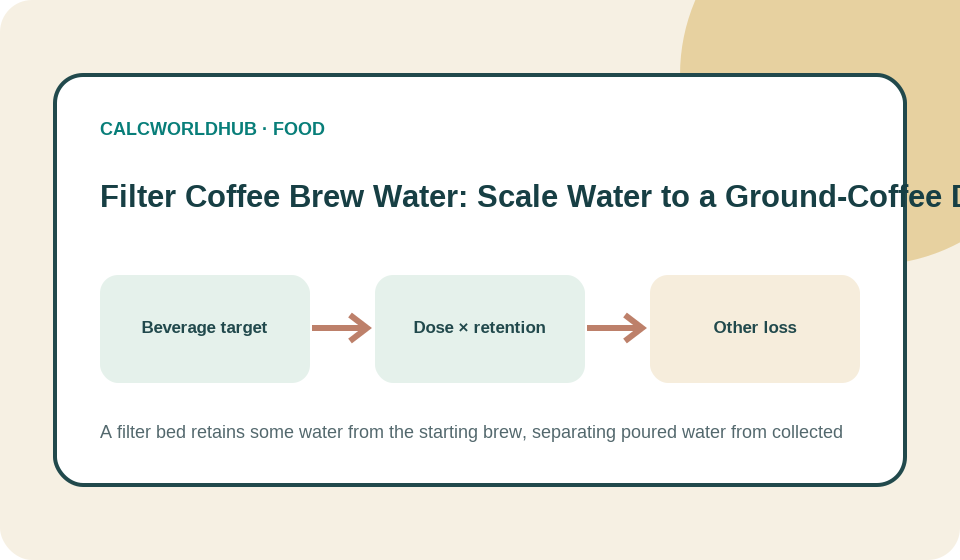
Work backward from the beverage mass you want in the cup. Add water retained by the dry coffee and any other entered water loss.
How to use this calculator
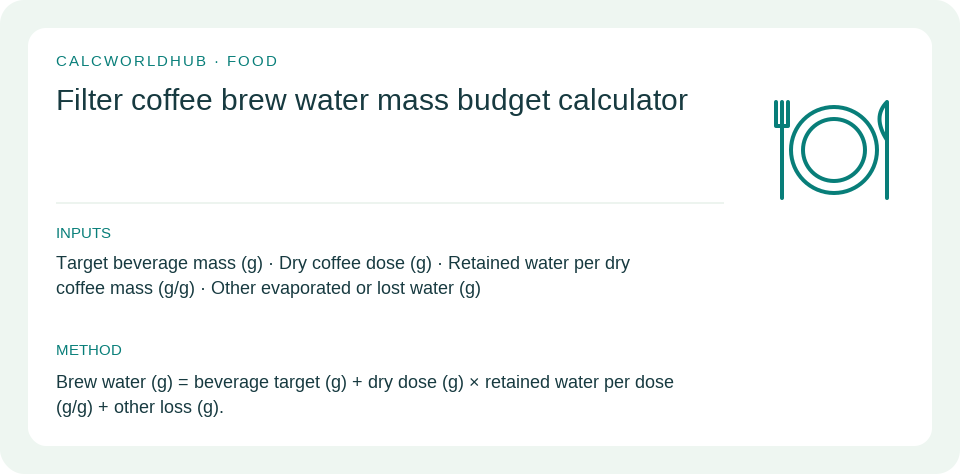
Estimate brew-water mass from target beverage, coffee dose, retained water, and other measured losses.
- Enter Target beverage mass (g), Dry coffee dose (g), Retained water per dry coffee mass (g/g), Other evaporated or lost water (g). Match the units shown beside each field and review the result together with the assumptions below.
- Read the worked example below to check the expected input format and result.
- Compare another scenario by changing one input at a time. Use Reset to return to the starting values.
Filter coffee brew water mass budget calculator
Work backward from the beverage mass you want in the cup. Add water retained by the dry coffee and any other entered water loss.
What it measures
This is a mass budget: total input water must cover the liquid beverage plus water held by grounds and other losses.
Inputs and units
- Target beverage mass (g): Target beverage mass collected in the cup, in grams.
- Dry coffee dose (g): Dry coffee dose in grams; it must be positive.
- Retained water per dry coffee mass (g/g): Water retained per gram of dry coffee, in g/g; enter a nonnegative measured estimate.
- Other evaporated or lost water (g): Other evaporated or lost water in grams, excluding retention already represented by the ratio.
Formula and method
Brew water (g) = beverage target (g) + dry dose (g) × retained water per dose (g/g) + other loss (g).
Worked example
For 500 g beverage, 30 g coffee, a retained ratio of 2 g/g, and 10 g other loss: 500 + 30×2 + 10 = 570 g water.
Interpreting the result
The output is the approximate water mass to start with, not beverage strength or extraction yield. Each loss term should describe the same brew.
Assumptions and limits
Retention varies with grind, filter, roast, and technique. The simple budget treats the entered ratio and extra loss as measured constants and omits evaporation during the brew unless included in other loss.
Frequently asked questions
Why is brew-water mass higher than beverage mass?
Some water remains in the coffee bed or is otherwise lost before the beverage is collected.
Does this calculate brew ratio or extraction yield?
No. It balances water mass only; it does not calculate dissolved solids or extraction yield.
How do I use the Filter coffee brew water mass budget calculator?
Enter Target beverage mass (g), Dry coffee dose (g), Retained water per dry coffee mass (g/g), Other evaporated or lost water (g). Match the units shown beside each field and review the result together with the assumptions below.
What is a worked example of Filter coffee brew water mass budget?
For 500 g beverage, 30 g coffee, a retained ratio of 2 g/g, and 10 g other loss: 500 + 30×2 + 10 = 570 g water.
What does the Filter coffee brew water mass budget calculator calculate?
Estimate brew-water mass from target beverage, coffee dose, retained water, and other measured losses.
See the calculation methodology.