
Brew ratio helps choose a target, not the full water budget
A ratio recipe can help determine a target, but define whether its water mass means water poured, beverage collected, or another measurement point before entering the calculator.
This calculator has no brew-ratio field. It accepts a target beverage mass, then adds estimated grounds retention and other stated loss. A ratio is a recipe convention; this tool is a simple water mass budget. SCA research discusses brew ratio as a mass relationship, but the calculation does not predict flavor.
Understand the four inputs
Target beverage mass is the amount you want to collect. Dry coffee dose is the ground coffee before brewing. Retention is an entered grams-per-gram assumption for water held in the bed. Other loss is a separate allowance for water that does not become beverage, such as a measured process loss.
The retained-water factor is not measured automatically; use a documented assumption or derive it from repeated measurements with the same brewer and drain procedure.
Worked examples
These examples hold the mass-balance inputs apart so each retained-water assumption is visible.
A 450-gram beverage target
Inputs: Target beverage = 450 g; dry dose = 27 g; retained water = 2.1 g/g; other loss = 8 g.
Calculation: Starting water = 450 g + 27 g × 2.1 g/g + 8 g = 514.7 g.
The estimated water budget is 514.7 g under the entered retention and loss assumptions.
A larger target with a different dose
Inputs: Target beverage = 700 g; dry dose = 40 g; retained water = 2.0 g/g; other loss = 15 g.
Calculation: Starting water = 700 g + 40 g × 2.0 g/g + 15 g = 795 g.
The estimated starting water is 795 g; actual beverage mass should be checked by weighing the brew.

Apply the mass-balance equation
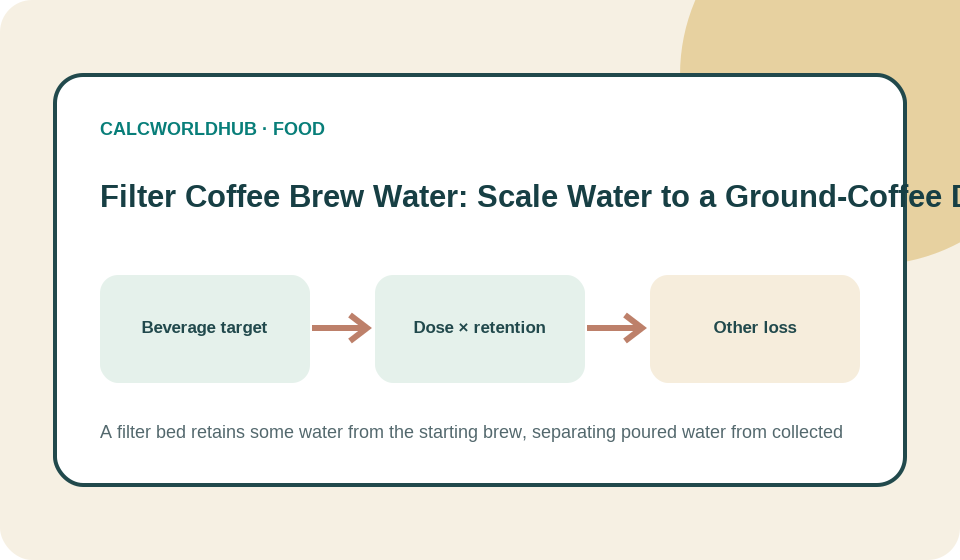
The formula is initial water = target beverage mass + dry coffee dose × retained water per gram + other water loss. The multiplication converts the per-gram retention assumption into a retained-water mass; adding the target and other-loss term then yields grams of starting water. The same unit chain should be used for every input.
This is a simplified balance because the equation does not add the mass of dissolved coffee solids that move from grounds into the drink. That omitted term can make the collected beverage mass differ slightly from a strict laboratory mass balance. Treat the estimate as a repeatable recipe starting point, not a precision measurement of every transfer.
Keep retention and other loss separate
Retention represents water associated with the dose under the chosen assumption. Other loss is a distinct allowance, not a second copy of the same grounds retention. If a measured setup loss already includes water held by grounds, adding it again in both fields double-counts that amount. Define the measurement boundary before entering either value.
Retention can differ with grind, filter, brewer, pouring pattern, and draining time. A factor measured in one brewing setup may not transfer exactly to another. If consistency matters, use a repeatable protocol: weigh the dry dose, input water, and collected beverage, then calculate the loss using the same drain and timing rule across trials.
Tune a recipe without overreading the number
The result estimates starting water under the chosen mass-budget assumptions. It does not determine total dissolved solids, extraction yield, flavor balance, or cup strength. Those also depend on grind size, water chemistry, temperature, contact time, and brewer geometry.
Specialty Coffee Association research describes relationships among brew ratio, beverage strength, and extraction, while cautioning against treating a single chart as a universal sensory rule. Use this result to set a repeatable starting recipe, then adjust from measured outcomes and taste. Keep one variable fixed when comparing a change so the effect of a new dose or retention assumption remains interpretable.
Round to the scale you actually use
The displayed output can include a fraction of a gram. A kitchen scale that reads only whole grams cannot deliver that exact mass, and the retention assumption may be less certain than the display. Round to a practical scale increment and record the rounded poured amount alongside the intended beverage target.
If collected beverage differs consistently from the target, update the retention or other-loss assumption from measured trials rather than adding arbitrary water. Check that the target is cup mass, not poured-water mass. A transparent budget makes adjustments repeatable, while the weighed cup shows what the process actually produced.