
What the yield percentage means
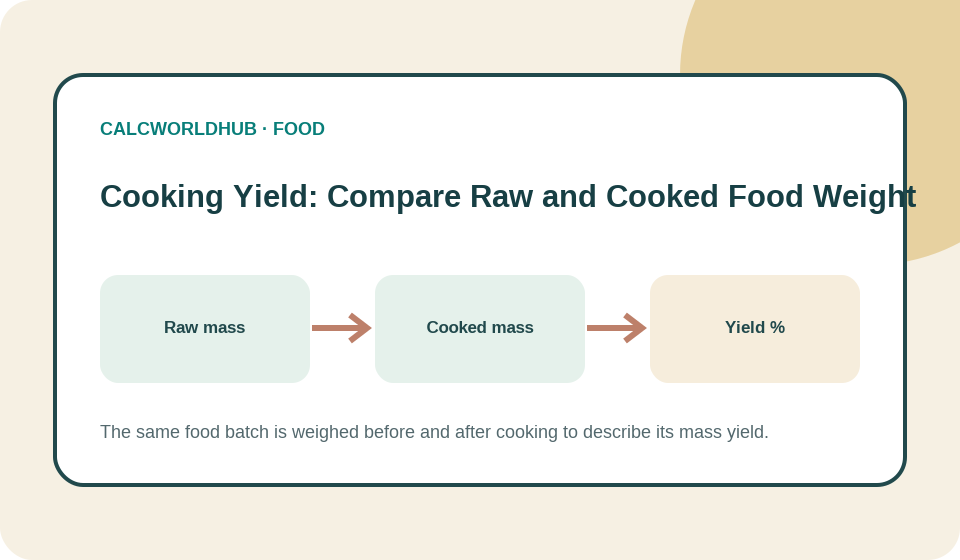
The result describes cooked mass as a share of the raw reference. It does not mean that the same share of nutrients remain, that the sample is safe to eat, or that every piece in a larger batch will have exactly the same yield.
The USDA Agricultural Research Service reports cooking yield from raw and final cooked weights in its yield tables. Those values are tied to specific cuts, preparation procedures, and cooking conditions. The percentage is useful as a measurement for a defined process; it is not a universal constant for a food name alone.
Weigh comparable portions
Record the raw mass and cooked mass for the same sample or batch boundary. Use grams for both or kilograms for both; the ratio is unchanged by a consistent unit conversion. If bones, packaging, marinade, drained liquid, or rendered fat are included in one measurement but excluded from the other, the result mixes different definitions and is difficult to interpret.
For a repeatable kitchen or production study, note the cut or product, trim, cooking equipment, method, time, target temperature, resting period, and whether the sample was drained before weighing. The calculator only receives two mass values, so those process details must be kept in a separate record if the result is meant to guide purchasing or portion planning.
Worked examples
Both examples use matching mass units and compare cooked mass with the raw starting mass.
A batch with three quarters of its starting mass
Inputs: Raw mass = 2.4 kg; cooked mass = 1.8 kg.
Calculation: Cooking yield = 1.8 kg ÷ 2.4 kg × 100 = 75%.
The cooked batch retains 75% of its measured starting mass; the calculation does not identify the lost material.
A smaller sample with a higher measured yield
Inputs: Raw mass = 850 g; cooked mass = 697 g.
Calculation: Cooking yield = 697 g ÷ 850 g × 100 = 82%.
Under the recorded process, cooked mass is 82% of the raw reference mass.

Apply the raw-to-cooked formula
The equation is cooked mass ÷ raw mass × 100. The quotient expresses what share of the starting mass remains after the chosen preparation. Keep the raw and final weights tied to the same sample and process; the difference is a measured mass change, not a breakdown of which substance left or entered the food.
A result above 100% is mathematically possible when the cooked sample absorbs water or when the two weighings use different boundaries. Before interpreting a high value as a property of the food, check drainage, added liquid, and tare. The percentage is not forced into a 0–100 range by the concept itself, even if a particular report expects a cooking-loss process.
Use a measured yield for serving estimates
If a recipe begins with a known raw mass and a target cooked serving weight, a measured yield can help estimate how many portions the batch may provide. Divide the cooked mass by the chosen serving mass only after deciding whether bones, sauce, and side ingredients count. That portion calculation is separate from the yield percentage.
The USDA Food Buying Guide explains how cooking method and product yield influence the raw quantity needed for a stated cooked serving plan. Its guidance and yield tables are more specific than a two-input calculator because they distinguish products and preparation methods. Use a local yield study where your process differs from published conditions or where small changes have a material purchasing effect.
Do not infer nutrition or food safety
A lower cooking yield often signals greater mass loss, but it does not say which nutrients were retained or how much energy is present per cooked gram. Nutrient retention depends on food composition and preparation details that are not represented in the two weights. Use a suitable composition database or laboratory method for nutritional analysis.
Likewise, weight does not establish a safe internal temperature or handling history. Follow the applicable food-safety advice for the specific product. This article and calculator describe a mass ratio only. Keeping that boundary clear prevents a simple yield percentage from being mistaken for a complete quality, safety, or nutrition measurement.
Round after comparing the weights
The displayed percentage may be rounded to a fixed number of decimal places. Keep the measured weights at their recorded precision and compare the unrounded quotient when evaluating small process changes. If a scale reads only to the nearest gram, displaying six decimals does not create six-decimal measurement certainty.
Compare like with like: same product specification, same raw-trim rule, and same cooked endpoint. A 78% yield from one cooking method cannot be compared cleanly with a 72% yield from another unless the measurement definitions align. Once the method is documented, the percentage is a compact way to monitor the result of that particular process over time.