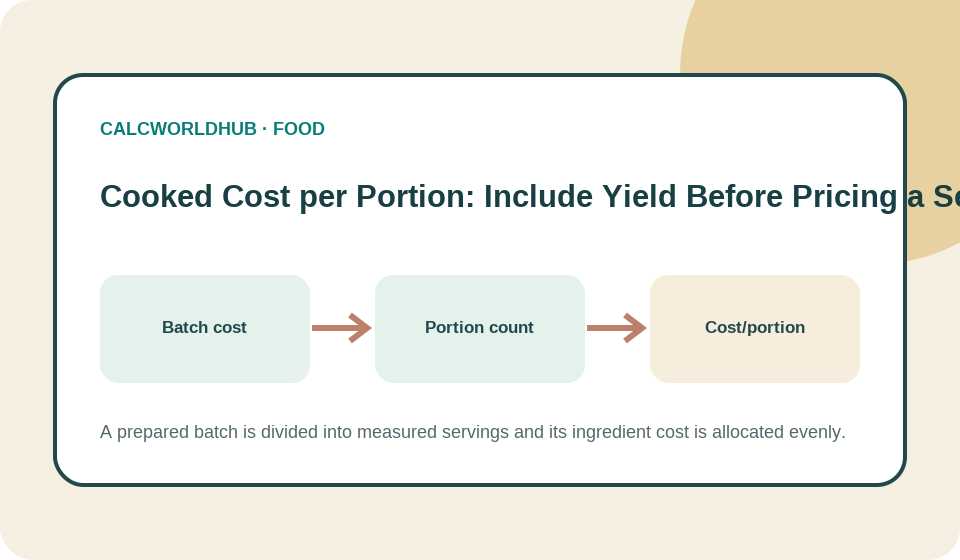

Define the cost assigned to the batch
The cost input should represent the ingredient cost you want to allocate across the batch. If you use an invoice price for a package, first calculate the amount of each ingredient actually used and sum those amounts using a consistent cost basis. This calculator has one cost field, so it cannot determine recipe cost from a list of ingredients or package prices.
The result is only as complete as the amount entered. Labor, energy, rent, packaging, spoilage, delivery fees, and overhead are not separate inputs. Add those costs before calculation only if your intended metric includes them, and label the result accordingly. For a food-service ingredient-cost comparison, keep the input limited to recipe ingredients and report other operating costs separately.
Count portions from the cooked batch
Enter the number of portions the prepared batch actually yields at the serving size you plan to use. Do not substitute a guest forecast unless it matches the portions that can be served.
Portion size is not a calculator field. If the portions vary, the average cost per portion may hide that variation. A smaller scoop and a larger scoop receive the same calculated cost in this simple division. Standardized serving weights, recipe records, and a consistent yield study make the denominator more reliable.
Worked examples
The examples show the batch cost and serving count separately; the result depends on both inputs being defined consistently.
A twelve-portion stew batch
Inputs: Ingredient cost assigned to the batch = $84; cooked portions = 12.
Calculation: Cost per portion = $84 ÷ 12 = $7.00 per portion.
The entered ingredient cost averages $7.00 across each of the twelve portions.
A smaller batch with more portions
Inputs: Ingredient cost assigned to the batch = $63.75; cooked portions = 15.
Calculation: Cost per portion = $63.75 ÷ 15 = $4.25 per portion.
The average ingredient cost is $4.25 for each portion at the stated batch yield.

Divide batch cost by portions
The formula is ingredient cost ÷ cooked portions. Currency cancels only in the sense that the output remains in the same currency per portion: dollars divided by servings gives dollars per serving. The result is an arithmetic average, not a price recommendation or a profit margin.
For a fixed batch cost, a larger number of equal portions lowers the average cost assigned to each one; fewer portions raise it. This relationship holds only when the cost boundary stays the same. If a batch is discarded or yields an extra portion, update the denominator to match what can actually be served.
Use a yield basis that matches service
For purchasing and menu planning, a yield is the amount of usable food after preparation divided into the portions you intend to serve. Trimming, cooking loss, drained liquid, and discarded portions can affect how much food reaches the plate. The USDA Food Buying Guide describes using cooking yields and portion sizes to estimate how much raw food is needed for a target number of servings.
This tool accepts the final portion count rather than raw and cooked weights. If you need to derive that count, weigh the usable cooked batch, choose a portion weight, and divide; then use the resulting count here. Keep any partial portion rule explicit. A theoretical count of 12.4 plates is not the same operationally as twelve full portions unless the remaining food is intentionally allocated.
Separate cost per serving from selling price
Cost per portion is one input to pricing, but it is not a menu price. A selling price may also need to account for labor, taxes, payment fees, waste, service style, market positioning, and the desired contribution toward fixed expenses. Comparing ingredient cost alone can help identify an expensive recipe, but it cannot determine whether the selling price is sustainable.
The field is labeled with a dollar sign, so enter costs in dollars and keep their costing date consistent. Supplier prices can change, and a historic recipe cost may not match current replacement cost. State whether the amount reflects purchase cost, standard cost, or a documented invoice period so a later comparison does not mistake an input change for a recipe improvement.
Round the displayed average appropriately
The calculator displays a rounded currency result. Keep the unrounded quotient when aggregating servings or comparing a large menu; round only for presentation. Cash rounding and sales-tax rules are separate from this ingredient-cost calculation.
If the result seems implausibly high or low, check that the cost is for the complete batch and the denominator is the number of cooked portions, not the raw serving plan. The USDA notes that product, preparation method, and yield influence food quantities needed. A clean cost-per-portion estimate begins with measured yield and transparent cost boundaries.