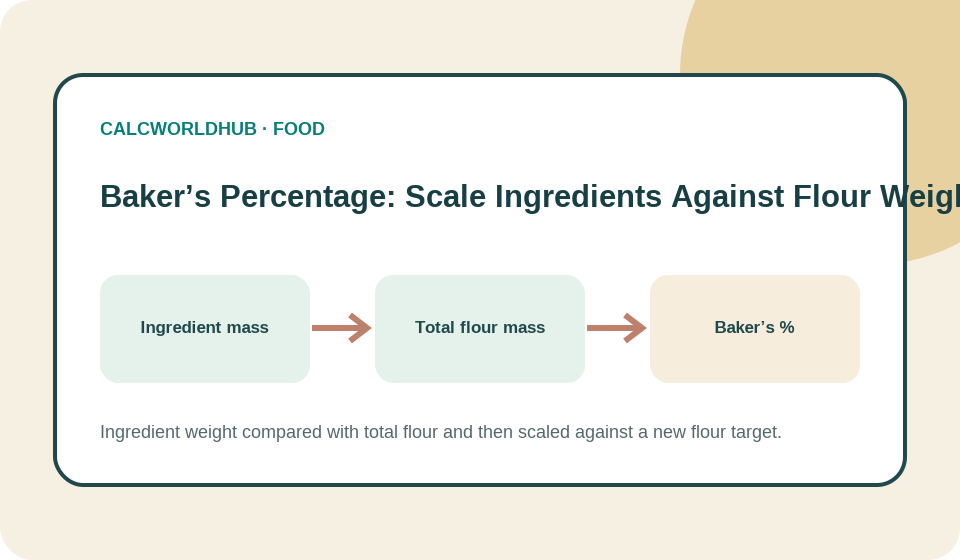

Why flour is the reference
In baker’s math, total flour is assigned 100%. Each other ingredient is compared with that flour mass, whether the ingredient is water, salt, yeast, fat, or a grain. This shared reference lets a baker compare formulas of different batch sizes without changing their proportions. It does not mean flour is 100% of the dough; water and other ingredients add mass beyond the flour.
The convention is useful because many bread formulas contain several flour sources. If a recipe uses white flour plus whole-grain flour, add those masses for the denominator when the formula defines both as flour. Do not use the weight of one flour bag or one subcomponent if the dough contains more flour elsewhere. Record the same recipe boundary every time you compare percentages.
Read the two inputs
The flour input is the total flour mass for the formula. The ingredient input is the mass of one ingredient whose percentage you want to express. Both values need the same mass unit: grams with grams, or ounces with ounces. Converting both consistently does not change the result, because the units cancel in the ratio.
This calculator evaluates one ingredient at a time. It does not add all ingredients, scale a full recipe, or decide whether a formula is balanced. To scale a recipe, first find each ingredient percentage, then multiply each percentage by the new flour target and divide by 100. Keep a written ingredient list so no flour or ingredient is omitted from the chosen batch.
Use the formula
A percentage uses flour mass as its denominator, not the dough’s combined mass.
When the target flour mass changes, multiply it by the ingredient percentage and divide by 100 to recover the ingredient mass for the new batch. Keep the percentage unrounded until that final scale step. The formula describes a mass relationship; it does not establish a preferred amount for every bread style or ingredient.
Include preferments deliberately
A preferment or sourdough starter can contain both flour and water. For a complete dough formula, count the preferment’s flour in total flour and its water in total water when those components are known. Otherwise the calculated percentage describes only the ingredients you entered, and a hydration or salt comparison may be misleading.
The tool has no separate fields for starter composition, multiple flours, or ingredient categories. You can still use it by first calculating the relevant totals yourself. State whether the starter is included and how its flour is allocated. Two recipes can show different percentages simply because one baker includes preferment flour in the denominator and another reports only the flour added at final mixing.
Keep mass and interpretation consistent
Use weighed masses rather than volume measures when possible. A cup of flour can vary with how it is filled and settled, so a volume-to-mass assumption can introduce error before the percentage calculation begins. Use the mass actually added, not the full package amount.
The percentage describes a formula; it does not predict dough strength, fermentation speed, loaf volume, or a preferred texture on its own. Flour absorption, protein, milling, temperature, mixing, and fermentation also matter. King Arthur’s professional reference defines baker’s percentage by comparing ingredients with flour weight, so use it as clear notation rather than a complete baking model.
Worked examples
The worked examples keep the flour denominator explicit so a small ingredient percentage is not mistaken for its share of the whole mix.
Salt at two percent
Inputs: Total flour = 800 g; salt = 16 g.
Calculation: Baker’s percentage = 16 g ÷ 800 g × 100 = 2%.
The salt mass is 2% of flour mass by weight.
A spice blend against a larger flour batch
Inputs: Total flour = 1,250 g; spice blend = 37.5 g.
Calculation: Baker’s percentage = 37.5 g ÷ 1,250 g × 100 = 3%.
The spice blend is 3% of the flour mass; the percentage is not its share of total dough.

Round for communication, not for scaling
Keep the full ratio when scaling and round ingredient masses only to a precision your scale can measure. If a calculated ingredient amount is 1.76 g, rounding it to 2 g may be reasonable for a home batch, but it changes the actual percentage slightly. For a small test dough, measuring resolution can be more important than displaying extra decimal places.
When comparing formulas, use the same flour denominator and ingredient definition. A percentage can be compared only when both recipes count flour and ingredients on the same basis. That consistency makes the notation useful for scaling and discussion without suggesting percentages alone guarantee the same result.