Baker’s percentage calculator
Compare an ingredient’s weight with the flour reference used in baker’s math.
inputs.
Calculator
How to use this calculator
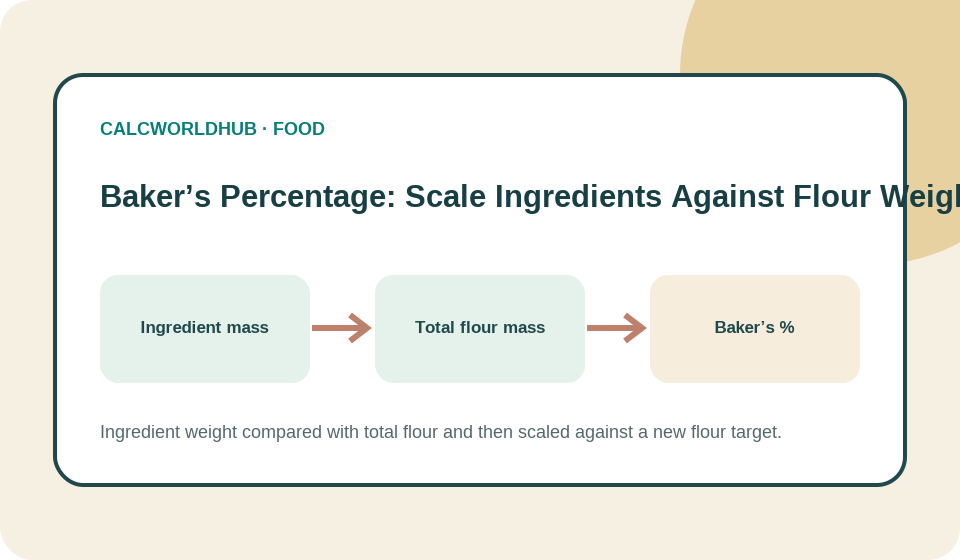
Calculate an ingredient’s baker’s percentage from its mass and the recipe’s total flour mass.
- Enter Flour mass (g), Ingredient mass (g). Match the units shown beside each field and review the result together with the assumptions below.
- Read the worked example below to check the expected input format and result.
- Compare another scenario by changing one input at a time. Use Reset to return to the starting values.
Express an ingredient mass relative to flour mass
Baker’s percentage sets flour mass to 100% and expresses each other ingredient by weight against that flour amount. It helps compare and scale formulas without treating the percentages as shares of the finished dough.
Inputs and units
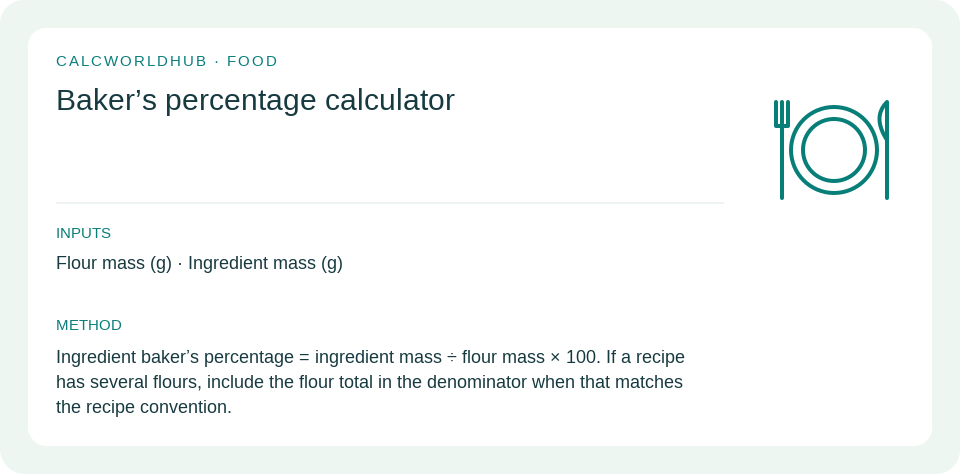
- Flour mass (g): Total flour mass in the formula; the calculation uses it as the 100% reference.
- Ingredient mass (g): Mass of one ingredient, in the same unit as flour.
Formula and method
Ingredient baker’s percentage = ingredient mass ÷ flour mass × 100. If a recipe has several flours, include the flour total in the denominator when that matches the recipe convention.
Worked example
For 500 g flour and 350 g water, 350 ÷ 500 × 100 = 70%. In a scaled batch with 750 g flour, a 70% water level is 0.70 × 750 = 525 g water.
Interpreting the result
A 70% water percentage means the water weighs 70% as much as the flour. It is not 70% of the total dough. Ingredient percentages can exceed 100% when an ingredient weighs more than the flour reference.
Assumptions and limits
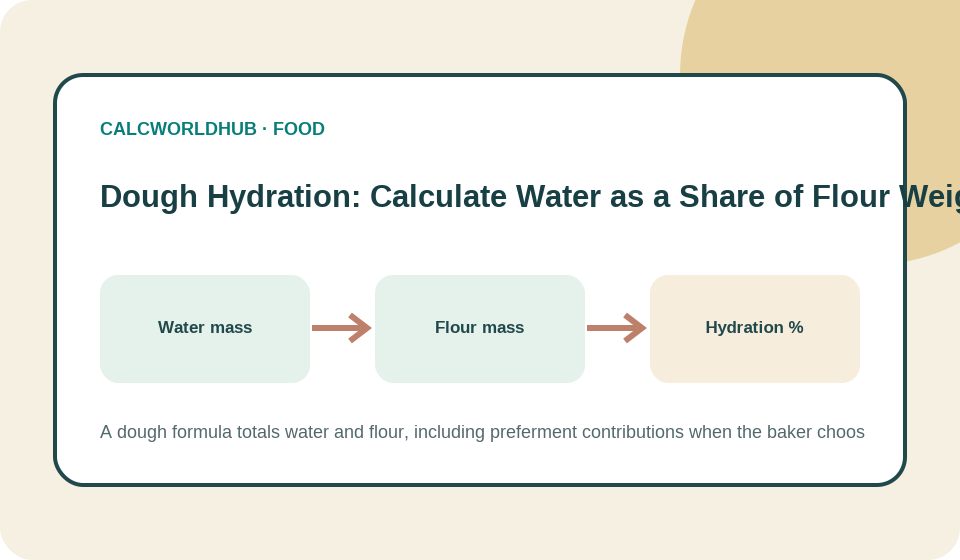
Weigh ingredients rather than converting volume measures without a density basis. The result compares one ingredient with flour; it does not calculate dough yield, hydration across several ingredients, fermentation, or recipe suitability.
Method references
Frequently asked questions
Can an ingredient percentage be above 100%?
Yes. The percentage is relative to flour mass, not a portion of the finished dough. An ingredient heavier than the flour produces a value above 100%.
How do I use the Baker’s percentage calculator?
Enter Flour mass (g), Ingredient mass (g). Match the units shown beside each field and review the result together with the assumptions below.
What is a worked example of Baker’s percentage?
For 500 g flour and 350 g water, 350 ÷ 500 × 100 = 70%. In a scaled batch with 750 g flour, a 70% water level is 0.70 × 750 = 525 g water.
What does the Baker’s percentage calculator calculate?
Calculate an ingredient’s baker’s percentage from its mass and the recipe’s total flour mass.
What assumptions apply to Baker’s percentage?
Weigh ingredients rather than converting volume measures without a density basis. The result compares one ingredient with flour; it does not calculate dough yield, hydration across several ingredients, fermentation, or recipe suitability.
Good calculators show their work.
CalcWorldHub is built around clear inputs and visible assumptions. Results are estimates for planning; check official sources or your provider’s terms when exact figures matter.