
Hydration is a ratio, not a texture score
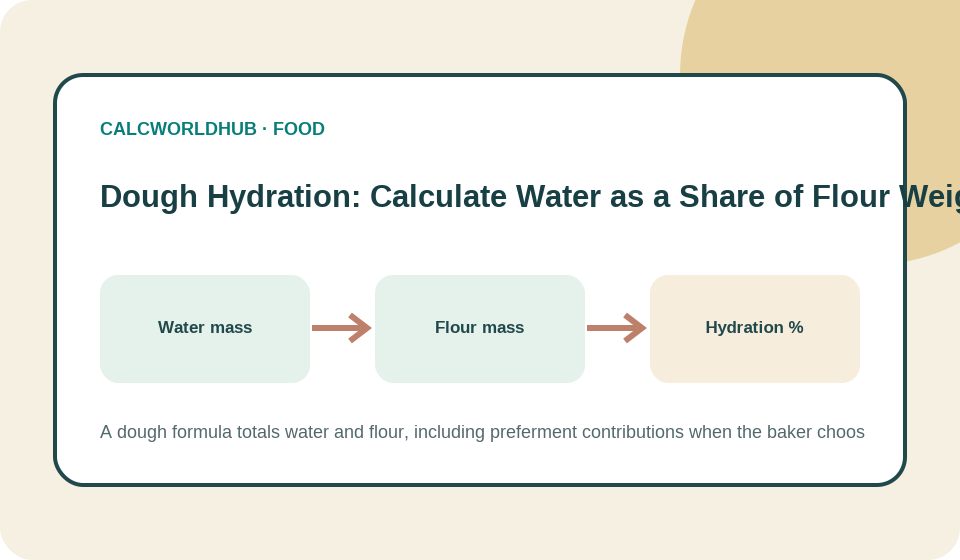
The basic hydration formula is water mass ÷ flour mass × 100. A value of 70% means 70 g of water for each 100 g of flour under the selected formula boundary. It is a useful shorthand for comparing doughs, but it does not by itself predict whether a dough will feel sticky, slack, extensible, or easy to shape.
Flour type, milling, protein, bran, temperature, mixing, rest time, salt, fat, sugar, and fermentation can affect handling. Two doughs at the same calculated hydration may behave differently. The percentage describes the ratio of the weights entered, not an objective grade for the dough or a guarantee of a particular crumb.
Enter total water and flour deliberately
Use the total water mass and the total flour mass that correspond to the dough you want to describe. Weigh both in grams or both in another consistent mass unit. Water entered as volume must be converted to mass before comparison if precision matters; do not compare millilitres directly with grams unless the conversion assumption is understood.
If a sourdough starter or preferment is part of the formula, include the flour and water it contributes when those amounts are known. For a 100% hydration starter, its mass is split equally between flour and water by weight. Omitting starter flour from the denominator while including starter water in the numerator makes the reported hydration higher than the full-formula ratio.
Worked examples
The examples use water and flour weights on the same scale and show the denominator explicitly.
A moderate hydration dough
Inputs: Water = 360 g; flour = 500 g.
Calculation: Hydration = 360 g ÷ 500 g × 100 = 72%.
The entered water mass is 72% of the entered flour mass.
A larger flour batch with less water per flour mass
Inputs: Water = 440 g; flour = 640 g.
Calculation: Hydration = 440 g ÷ 640 g × 100 = 68.75%.
The ratio is 68.75%; compare it with another dough only if both use the same inclusion rule for preferments and liquids.

Calculate the water-to-flour percentage
Divide water by flour, then multiply by 100. The ratio is dimensionless and expresses how much entered water there is relative to the entered flour. With the flour total fixed, increasing water raises hydration; adding flour without adding water lowers it. Both comparisons assume the same formula boundary.
The calculator accepts one water weight and one flour weight. It does not sum several liquids, calculate starter composition, or distinguish water from milk, eggs, syrup, or melted butter. Some bakers track those ingredients in broader formula percentages; for a water-only hydration figure, decide which liquid components count and disclose the convention rather than silently treating every ingredient as water.
Scale a dough without changing its ratio
A flour target can be used to derive water with water mass = hydration percentage ÷ 100 × flour mass. This reverse calculation supports scaling, but it does not choose the hydration that suits a particular flour or baking method.
When scaling a full recipe, scale every ingredient against the same flour basis. Salt, yeast, starter, inclusions, and any non-water liquids can affect dough behavior, even though the hydration calculator does not model them. Record those ingredients separately and use a baker’s percentage table if the goal is to compare or resize an entire formula.
Interpret a result within the recipe
A higher number usually means more entered water for the same entered flour, but dough handling cannot be inferred from that number alone. Whole-grain flour and high-bran doughs may absorb water differently from refined flour. A change in flour brand or lot may alter the feel without changing the calculated ratio.
King Arthur’s hydration discussion describes hydration as water weight divided by flour weight and notes that preferments can contribute flour and water to the totals. Use a consistent inclusion rule when comparing recipes. If you change the rule between batches, an apparent hydration change may reflect bookkeeping rather than a change in the dough itself.
Use measured precision and avoid false certainty
The tool displays a rounded percentage. Keep the original weights for recipe records and round the final display to a useful precision. A difference such as 0.2 percentage points may be smaller than the weighing uncertainty or the variation in how a baker defines a starter’s composition.
The result is a formula aid, not a fermentation forecast. It does not account for absorption over time, evaporation, dough temperature, or process losses. Use measured ingredients, a consistent starter convention, and process notes to make comparisons meaningful. The final dough still needs to be assessed in the context of its flour and method.