How to use this calculator
Estimate coffee extraction yield from beverage mass, dissolved-solids percentage, and dry coffee dose.
- Complete the labeled inputs for Coffee beverage extraction yield. Use the units requested by each field, then read the displayed result alongside the method and limits below.
- Read the worked example below to check the expected input format and result.
- Compare another scenario by changing one input at a time. Use Reset to return to the starting values.
From beverage strength to extracted mass
Formula and method
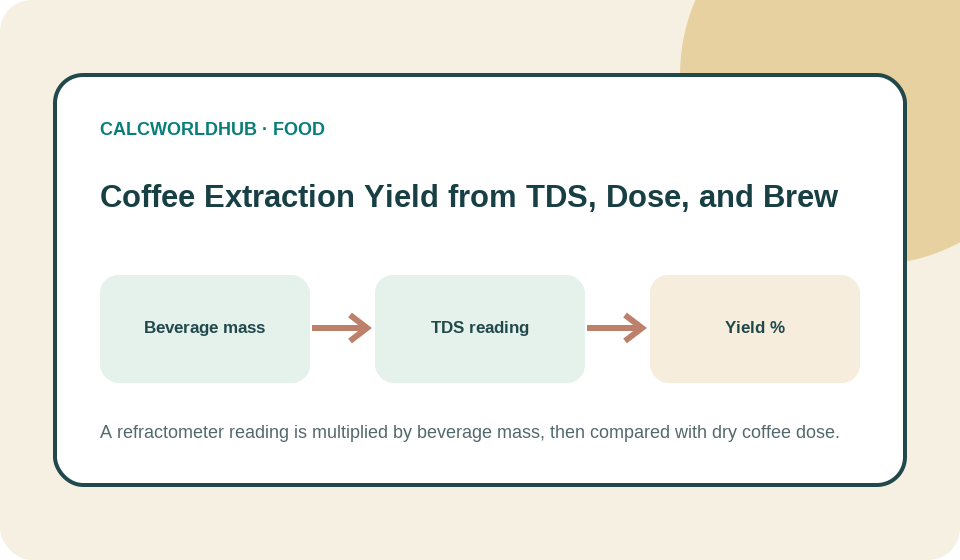
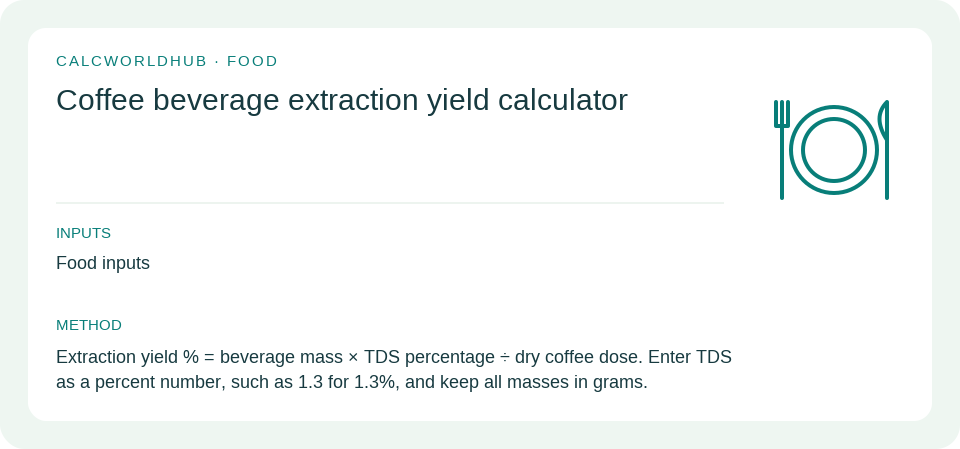
Extraction yield % = beverage mass × TDS percentage ÷ dry coffee dose. Enter TDS as a percent number, such as 1.3 for 1.3%, and keep all masses in grams.
Worked example
For a 300 g beverage at 1.3% TDS from a 20 g dose, dissolved-solids mass is 300 × 0.013 = 3.9 g. The yield is 3.9 ÷ 20 × 100 = 19.5%.
Interpreting the result
Extraction yield estimates the share of the dry coffee dose that entered the beverage as dissolved material. It is interpreted together with beverage strength and sensory preference.
Assumptions and limits
The result depends on accurate TDS measurement, beverage mass, and the chosen dose boundary. It does not describe flavor quality by itself; filter retention, refractometer calibration, and sampling can affect readings.
Sources and method notes
Frequently asked questions
Is TDS the same as extraction yield?
No. TDS is the concentration of dissolved solids in the beverage; extraction yield also uses beverage mass and dry coffee dose.
Does extraction yield alone predict flavor?
No. It describes a mass ratio, not sensory quality. Brew uniformity, water, roast, grind, and measurement quality also affect the cup.
Can I enter beverage volume in millilitres?
Use beverage mass in grams for this equation. Millilitres are not exactly grams unless you make a density approximation.
How do I use the Coffee beverage extraction yield calculator?
Complete the labeled inputs for Coffee beverage extraction yield. Use the units requested by each field, then read the displayed result alongside the method and limits below.
What is a worked example of Coffee beverage extraction yield?
For a 300 g beverage at 1.3% TDS from a 20 g dose, dissolved-solids mass is 300 × 0.013 = 3.9 g. The yield is 3.9 ÷ 20 × 100 = 19.5%.
Read our calculation methodology.