
Extraction and strength are not interchangeable
TDS is the concentration of dissolved material in the beverage. Extraction yield estimates how much of the dry coffee dose ended up dissolved in that beverage. A cup can be stronger because it contains more dissolved material per unit of liquid, while a different dose or beverage mass changes the extraction percentage. The calculator reports yield from all three entered values; it does not directly measure flavor balance.
Use a refractometer reading from a representative, well-mixed sample and record the dry coffee dose and beverage mass from the same brew. If a sample is not mixed, solids may be unevenly distributed and the TDS value may not represent the full beverage. The Specialty Coffee Association’s brewing material discusses strength and extraction as related but distinct measures, which is why keeping both measurements visible is useful.
Enter percent TDS as a percent
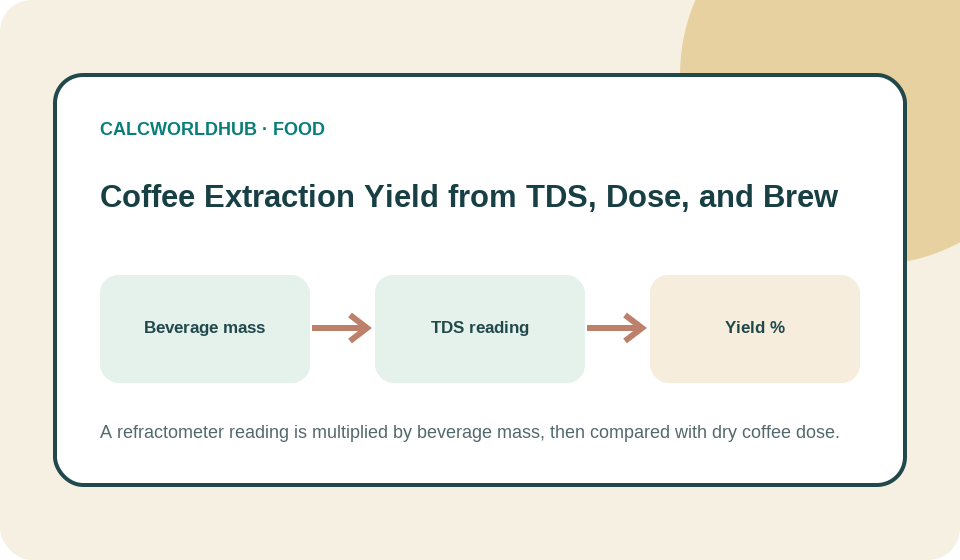
The fields are Beverage mass (g), Beverage dissolved solids (%), and Dry coffee dose (g). The relation is yield percentage = beverage mass × TDS percent ÷ dry dose. Because the TDS field is entered on a percent scale, 1.3 means 1.3%, and the formula produces 19.5 for 300 g beverage, 1.3 TDS, and a 20 g dose. Dividing the TDS field by 100 again would be a unit error for this calculator’s convention.
Beverage mass may be zero but a useful measurement is positive; TDS is constrained to 0–100, and dose must be positive. The UI exposes nonnegative beverage mass, a TDS maximum of 100, and a small positive minimum for dose. Use realistic values from a calibrated measurement rather than relying on these broad input bounds to decide whether a brew is plausible.
Carry the measured quantities through
The dimensional check is simple: grams of beverage multiplied by the dissolved-solids percentage number, then divided by grams of dry coffee, gives a percent-scale result. For a 20 g dose and 300 g beverage at 1.2% TDS, dissolved solids are 300 × 0.012 = 3.6 g; 3.6 ÷ 20 × 100 = 18%. The runtime’s compact form, 300 × 1.2 ÷ 20, reaches the same value because 1.2 is already a percentage number.
Keep unrounded quantities until the final display. The calculator formats the yield to four decimal places when necessary, so two different brews may appear equal after rounding even if their underlying ratios are slightly different. A rounded yield should not be reverse-engineered into a more precise dose or refractometer reading than the instruments supplied.
Worked examples
The two brews use different doses and beverage masses, with the arithmetic shown before final rounding.
A 20 g filter dose
Inputs: Beverage mass = 300 g; TDS = 1.2%; Dry coffee dose = 20 g.
Calculation: Extraction yield = 300 × 1.2 ÷ 20 = 18% (3.6 g dissolved solids ÷ 20 g dose).
The modeled beverage contains 3.6 g dissolved solids, equal to 18% of the dry dose.
A smaller beverage from an 18 g dose
Inputs: Beverage mass = 250 g; TDS = 1.4%; Dry coffee dose = 18 g.
Calculation: Extraction yield = 250 × 1.4 ÷ 18 = 19.444444…% ≈ 19.4444%.
The higher yield estimate follows from the measured TDS and beverage mass relative to dose; it does not by itself say which cup tastes better.

Compare brews on a controlled basis
For a useful comparison, hold the refractometer method, sample temperature, beverage definition, and dose weighing procedure steady. If one brew includes bypass water or excludes liquid retained in grounds while another uses a different beverage-mass convention, identical-looking TDS readings do not make their extraction estimates directly comparable. Write down whether beverage mass means the final liquid collected in the cup or another measured stream.
Changing dose-to-water ratio can alter strength even if extraction yield stays similar. Changing grind, water temperature, agitation, or brew time can affect how much material dissolves. This calculator does not include brew water input, grounds retention, or a brewing method selector; it trusts the measured beverage mass and TDS that you supply. Treat it as a measurement calculation, not a recipe optimizer.
Use published ranges as context, not a target
The SCA’s published brewer materials describe reference ranges for beverage strength and extraction under defined brewing protocols. Those ranges provide context for a particular style of brewing; they are not proof that every coffee, roast, method, or drinker should prefer the same result. Taste and repeatability remain part of the decision, and refractometer readings carry measurement uncertainty.
The estimate excludes refractometer calibration error, sample contamination, nonuniform mixing, and method-specific corrections. It does not establish safety or caffeine content. Use consistent measurements to learn how a process change affects the cup, and keep raw readings beside the rounded yield so the result can be reproduced.