How to use this calculator
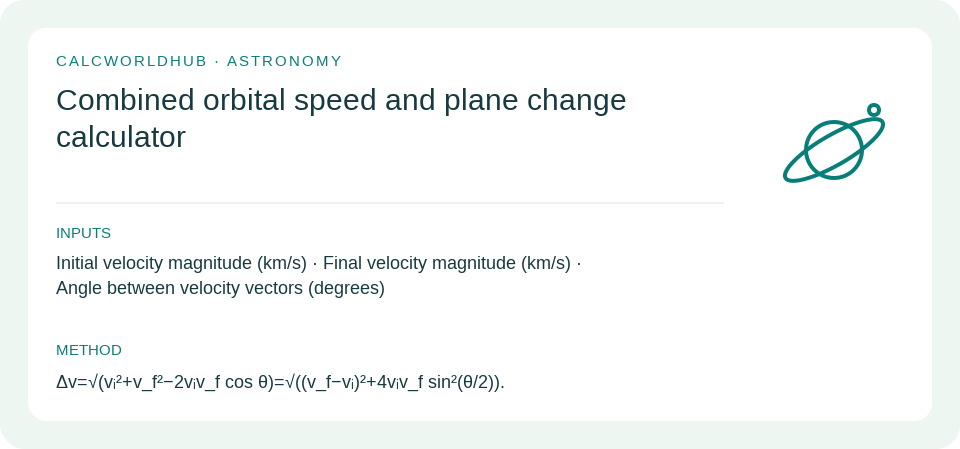
Compute the instantaneous velocity change needed to move from one velocity vector to another with a specified angle between them.
- Enter Initial velocity magnitude (km/s), Final velocity magnitude (km/s), Angle between velocity vectors (degrees). Match the units shown beside each field and review the result together with the assumptions below.
- Read the worked example below to check the expected input format and result.
- Compare another scenario by changing one input at a time. Use Reset to return to the starting values.
How Combined orbital speed and plane change calculator works
Compute the instantaneous velocity change needed to move from one velocity vector to another with a specified angle between them.
Inputs and units
- Initial velocity magnitude (km/s): Initial velocity magnitude is the speed before the maneuver, in km/s.
- Final velocity magnitude (km/s): Final velocity magnitude is the speed after the maneuver, in km/s.
- Angle between velocity vectors (degrees): Angle is the separation between the two velocity vectors, in degrees.
Formula and method
Δv=√(vᵢ²+v_f²−2vᵢv_f cos θ)=√((v_f−vᵢ)²+4vᵢv_f sin²(θ/2)).
Worked example
For vᵢ=7.5 km/s, v_f=8 km/s, and θ=10°, Δv=√(7.5²+8²−2·7.5·8·cos10°)≈1.439816 km/s.
Interpreting the result
This is the magnitude of the vector difference between the two velocities, not just the speed increase of 0.5 km/s.
Assumptions and limits
The model is an ideal instantaneous impulse at a common point. It excludes finite-burn gravity losses, propulsion constraints, transfer-orbit design, and timing/location effects.
Sources and method
- A velocity-vector change follows the law of cosines; a pure plane rotation has ΔV=2v sin(θ/2). NASA: plane-change capability
Frequently asked questions
Why is the result larger than the speed difference?
The velocity direction also changes, so the maneuver must supply both magnitude and direction change.
Does the angle use degrees?
Yes. The visible field is in degrees and is converted to radians for the trigonometric calculation.
How do I use the Combined orbital speed and plane change calculator?
Enter Initial velocity magnitude (km/s), Final velocity magnitude (km/s), Angle between velocity vectors (degrees). Match the units shown beside each field and review the result together with the assumptions below.
What is a worked example of Combined orbital speed and plane change?
For vᵢ=7.5 km/s, v_f=8 km/s, and θ=10°, Δv=√(7.5²+8²−2·7.5·8·cos10°)≈1.439816 km/s.
What does the Combined orbital speed and plane change calculator calculate?
Compute the instantaneous velocity change needed to move from one velocity vector to another with a specified angle between them.