How to use this calculator
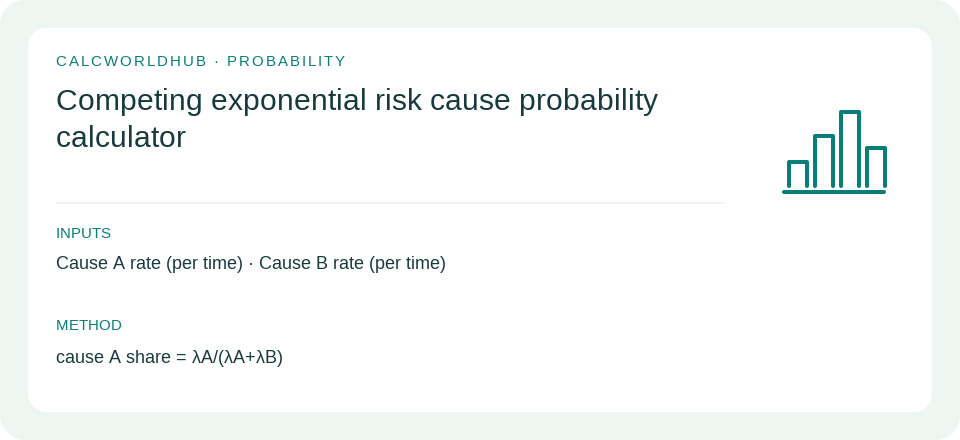
Estimate the eventual share of events attributed to one cause when two competing causes have constant exponential rates.
- Enter Cause A rate (per time), Cause B rate (per time). Match the units shown beside each field and review the result together with the assumptions below.
- Read the worked example below to check the expected input format and result.
- Compare another scenario by changing one input at a time. Use Reset to return to the starting values.
How Competing exponential risk cause probability calculator works
Estimate the eventual share of events attributed to one cause when two competing causes have constant exponential rates.
Inputs and units
- Cause A rate (per time): Enter cause A's nonnegative constant rate per time unit.
- Cause B rate (per time): Enter cause B's nonnegative constant rate using the same time unit; total rate must be positive.
Formula and method
cause A share = λA/(λA+λB)
Worked example
With constant rates 0.03 and 0.02 per year, cause A's share is 0.03/(0.03+0.02)=0.60.
Interpreting the result
The value is the proportion of eventual events attributed to cause A under the two-rate model, not the probability of an event by a specified time.
Assumptions and limits
Assumes constant cause-specific rates and the competing-exponential model. Rates must use the same time unit; both zero leaves the share undefined. Additional causes, time-varying hazards, and covariates are not modeled.
Frequently asked questions
Does 0.60 mean a 60% event risk in one year?
No. It is a cause share over eventual events in this two-rate model, not a finite-time cumulative risk.
Why is the cause share undefined when both rates are zero?
No events occur under zero total rate, so there is no event population to divide between causes.
How do I use the Competing exponential risk cause probability calculator?
Enter Cause A rate (per time), Cause B rate (per time). Match the units shown beside each field and review the result together with the assumptions below.
What is a worked example of Competing exponential risk cause probability?
With constant rates 0.03 and 0.02 per year, cause A's share is 0.03/(0.03+0.02)=0.60.
What does the Competing exponential risk cause probability calculator calculate?
Estimate the eventual share of events attributed to one cause when two competing causes have constant exponential rates.