How to use this calculator
Calculate concrete beam modulus of rupture from a third-point flexural test, including the correction for eligible near-support fractures.
- Enter Maximum total applied load, P (kN), Support span, L (mm), Average beam width, b (mm), Average beam depth, d (mm), then complete the remaining labeled fields. Match the units shown beside each field and review the result together with the assumptions below.
- Read the worked example below to check the expected input format and result.
- Compare another scenario by changing one input at a time. Use Reset to return to the starting values.
How this calculation works
Enter the total maximum applied load, support span, beam width and depth, and the fracture’s distance from its nearer support. The calculator applies the third-point loading equation and the standard near-support adjustment or flags a fracture outside the accepted range.
Inputs and units
peakLoadKn— Maximum total applied load, P (kN)- Total machine load at fracture for the two third-point loading noses combined.
spanMm— Support span, L (mm)- Distance between the two lower support points.
widthMm— Average beam width, b (mm)- Measured average width of the fractured concrete prism.
depthMm— Average beam depth, d (mm)- Measured average depth of the prism in the bending direction.
fractureDistanceMm— Fracture distance from nearer support, a (mm)- Distance from the fracture to the closer of the two supports; it cannot exceed half the span.
Formula
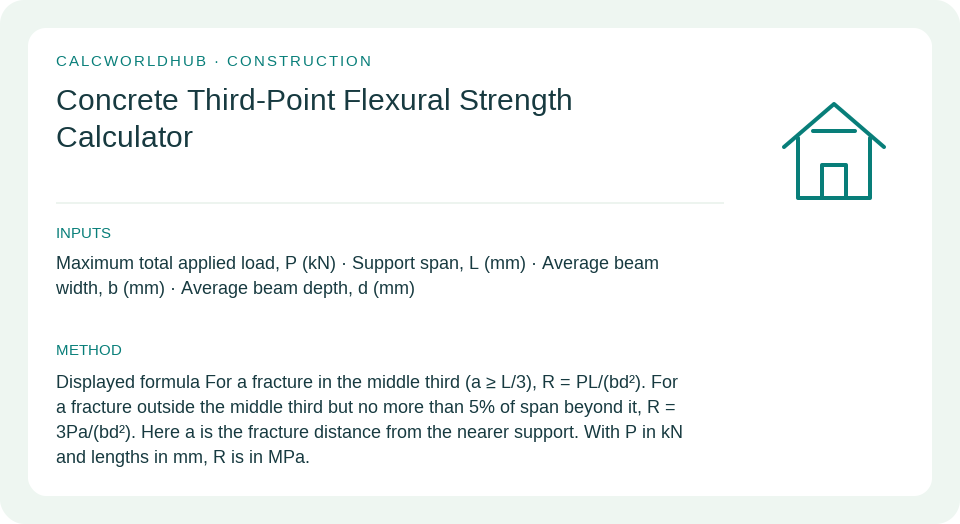
For a fracture in the middle third (a ≥ L/3), R = PL/(bd²). For a fracture outside the middle third but no more than 5% of span beyond it, R = 3Pa/(bd²). Here a is the fracture distance from the nearer support. With P in kN and lengths in mm, R is in MPa.
Method
For third-point loading, calculate the modulus of rupture from the maximum total applied load and specimen dimensions. A fracture inside the middle third uses PL/(bd²). A fracture just outside that region uses 3Pa/(bd²), where a is its distance from the nearer support; fractures farther than 5% of span outside the center third are rejected.
Worked example
For a 15.00 kN total load on a 450 mm span, a 150 mm × 150 mm beam fracturing in the middle third, R = PL/(bd²) = 2.0000 MPa. If the fracture is 130 mm from the nearer support, the near-support correction gives 1.7333 MPa.
Assumptions and limits
This is for a simply supported concrete prism with two equal loads placed at the span’s third points, matching the third-point flexural test. Enter total applied load, not the load at each loading nose. The near-support equation applies only when the fracture is outside the middle third by no more than 5% of span; fractures farther toward a support should be discarded. It does not calculate center-point loading or predict strength from concrete mix properties.
Frequently asked questions
What does third-point loading mean?
The beam is simply supported and the two equal loading noses act at the one-third and two-thirds points of the span.
Why does fracture location change the equation?
The standard beam equation assumes fracture in the middle third. A fracture just outside it uses a distance-adjusted result; a more distant near-support fracture is rejected.
Should I enter the load at each loading nose?
No. Enter the total maximum load reported by the testing machine for the pair of loading noses.
How do I use the Concrete Third-Point Flexural Strength Calculator?
Enter Maximum total applied load, P (kN), Support span, L (mm), Average beam width, b (mm), Average beam depth, d (mm), then complete the remaining labeled fields. Match the units shown beside each field and review the result together with the assumptions below.
What is a worked example of Concrete Third-Point Flexural Strength?
For a 15.00 kN total load on a 450 mm span, a 150 mm × 150 mm beam fracturing in the middle third, R = PL/(bd²) = 2.0000 MPa. If the fracture is 130 mm from the nearer support, the near-support correction gives 1.7333 MPa.
Reference: technical reference. See our calculation methodology.