How to use this calculator
Integrate the counterflow cooling-tower transfer requirement for a chosen water cooling range and air operating line.
- Enter Hot water inlet temperature (°C), Cold water outlet temperature (°C), Entering moist-air enthalpy (kJ/kg dry air), Liquid water / dry air mass-flow ratio, then complete the remaining labeled fields. Match the units shown beside each field and review the result together with the assumptions below.
- Read the worked example below to check the expected input format and result.
- Compare another scenario by changing one input at a time. Use Reset to return to the starting values.
Counterflow cooling tower Merkel transfer characteristic explained
Use Hot water inlet temperature (°C) with Cold water outlet temperature (°C) to reproduce the sample calculation, then review the stated limits before carrying the result into another scenario.
Inputs, symbols, and units
Th— Hot water inlet temperature (°C)- Hot water inlet temperature (°C). Enter the value for this state; the units shown are used without an unstated conversion.
Tc— Cold water outlet temperature (°C)- Cold water outlet temperature (°C). Enter the value for this state; the units shown are used without an unstated conversion.
hin— Entering moist-air enthalpy (kJ/kg dry air)- Entering moist-air enthalpy (kJ/kg dry air). Enter the value for this state; the units shown are used without an unstated conversion.
LG— Liquid water / dry air mass-flow ratio- Liquid water / dry air mass-flow ratio. Enter the value for this state; the units shown are used without an unstated conversion.
cp— Liquid-water heat capacity (kJ/kg/K)- Liquid-water heat capacity (kJ/kg/K). Enter the value for this state; the units shown are used without an unstated conversion.
p— Total air pressure (kPa)- Total air pressure (kPa). Enter the value for this state; the units shown are used without an unstated conversion.
Formula and method
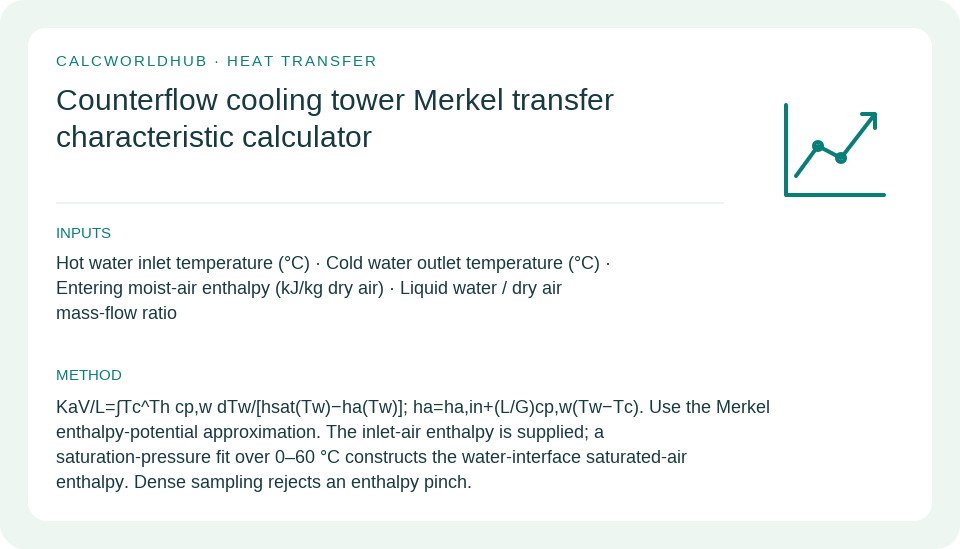
KaV/L=∫Tc^Th cp,w dTw/[hsat(Tw)−ha(Tw)]; ha=ha,in+(L/G)cp,w(Tw−Tc).
Use the Merkel enthalpy-potential approximation. The inlet-air enthalpy is supplied; a saturation-pressure fit over 0–60 °C constructs the water-interface saturated-air enthalpy. Dense sampling rejects an enthalpy pinch.
A worked scenario
Hot water inlet temperature (°C) = 40; Cold water outlet temperature (°C) = 30; Entering moist-air enthalpy (kJ/kg dry air) = 50; Liquid water / dry air mass-flow ratio = 1; Liquid-water heat capacity (kJ/kg/K) = 4.18; Total air pressure (kPa) = 101.325.
- Required Merkel characteristic KaV/L: 0.71404
- Leaving air enthalpy from balance: 91.8 kJ/kg dry air
- Minimum sampled enthalpy driving difference: 49.677483 kJ/kg dry air
Cooling water from 40 to 30 °C with liquid/dry-air ratio 1, inlet-air enthalpy 50 kJ/kg and pressure 101.325 kPa requires Merkel characteristic 0.714040. The operating balance brings leaving-air enthalpy to 91.8 kJ/kg dry air; the enthalpy driving force stays positive.
Assumptions and edge cases
Lewis factor one, negligible water-flow change through evaporation, constant liquid cp and counterflow contact. Not a fan-power or packing-height calculator; the minimum driving difference is a sampled diagnostic.
Reading the outputs
Transfer characteristic is dimensionless; leaving-air enthalpy and smallest sampled driving difference are kJ/kg dry air.
Frequently asked questions
Is KaV/L already a packing height?
No. Converting it to height needs an appropriate volumetric mass-transfer correlation and operating flow rates.
Why can more water flow make the target infeasible?
A higher L/G steepens the air operating line and can remove the enthalpy driving force.
Does this calculate evaporation loss?
No. Merkel neglects its effect on liquid flow; a fuller coupled heat/mass balance is needed for makeup water.
How do I use the Counterflow cooling tower Merkel transfer characteristic calculator?
Enter Hot water inlet temperature (°C), Cold water outlet temperature (°C), Entering moist-air enthalpy (kJ/kg dry air), Liquid water / dry air mass-flow ratio, then complete the remaining labeled fields. Match the units shown beside each field and review the result together with the assumptions below.
What is a worked example of Counterflow cooling tower Merkel transfer characteristic?
Hot water inlet temperature (°C) = 40; Cold water outlet temperature (°C) = 30; Entering moist-air enthalpy (kJ/kg dry air) = 50; Liquid water / dry air mass-flow ratio = 1; Liquid-water heat capacity (kJ/kg/K) = 4.18; Total air pressure (kPa) = 101.325. Required Merkel characteristic KaV/L: 0.71404 Leaving air enthalpy from balance: 91.8 kJ/kg dry air Minimum sampled enthalpy driving difference: 49.677483 kJ/kg dry air Cooling water from 40 to 30 °C with liquid/dry-air ratio 1, inlet-air enthalpy 50 kJ/kg and pressure 101.325 kPa requires Merkel characteristic 0.714040.
Background or definition reference: IIT NPTEL Merkel cooling tower equation.
Read our calculation methodology.