Cycling aerodynamic power calculator
Estimate the aerodynamic share of cycling power at a steady air-relative speed.
inputs.
Calculator
How to use this calculator
Estimate cycling power needed to overcome aerodynamic drag from speed, air density, and CdA.
- Enter Cycling speed (km/h), Air density (kg/m³), Drag area CdA (m²). Match the units shown beside each field and review the result together with the assumptions below.
- Read the worked example below to check the expected input format and result.
- Compare another scenario by changing one input at a time. Use Reset to return to the starting values.
Estimate power used to overcome aerodynamic drag
At a steady speed, aerodynamic power is drag force multiplied by speed through the air. This calculator uses air density, drag area, and cycling speed for that aerodynamic component only.
Inputs and units
- Cycling speed (km/h): Speed relative to the air; convert headwind or tailwind conditions into an air-relative speed if needed.
- Air density (kg/m³): Air mass per cubic meter under the ride’s temperature, pressure, and altitude conditions.
- Drag area CdA (m²): Product of the drag coefficient and frontal reference area for the rider and bicycle.
Formula and method
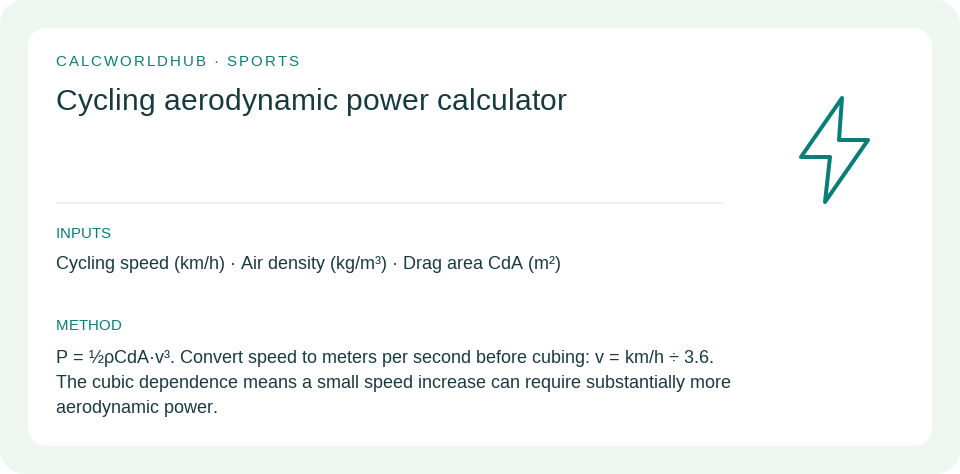
P = ½ρCdA·v³. Convert speed to meters per second before cubing: v = km/h ÷ 3.6. The cubic dependence means a small speed increase can require substantially more aerodynamic power.
Worked example
At 28 km/h, v = 28/3.6 = 7.7778 m/s. With ρ = 1.225 kg/m³ and CdA = 0.32 m², P = 0.5×1.225×0.32×7.7778³ ≈ 92.22 W.
Interpreting the result
About 92 W is the modeled power delivered against aerodynamic drag at that air-relative speed. Rider power at the pedals would be higher after rolling resistance, drivetrain loss, and any climbing demand are included.
Assumptions and limits
Assumes steady motion and supplied CdA and density. It excludes road gradient, tire rolling resistance, acceleration, drivetrain losses, drafting, and changes in wind or riding posture.
Method references
Frequently asked questions
Why does speed have a cube in the power formula?
Drag force grows approximately with speed squared; multiplying force by speed to obtain power adds one more factor of speed.
How do I use the Cycling aerodynamic power calculator?
Enter Cycling speed (km/h), Air density (kg/m³), Drag area CdA (m²). Match the units shown beside each field and review the result together with the assumptions below.
What is a worked example of Cycling aerodynamic power?
At 28 km/h, v = 28/3.6 = 7.7778 m/s. With ρ = 1.225 kg/m³ and CdA = 0.32 m², P = 0.5×1.225×0.32×7.7778³ ≈ 92.22 W.
What does the Cycling aerodynamic power calculator calculate?
Estimate cycling power needed to overcome aerodynamic drag from speed, air density, and CdA.
What assumptions apply to Cycling aerodynamic power?
Assumes steady motion and supplied CdA and density. It excludes road gradient, tire rolling resistance, acceleration, drivetrain losses, drafting, and changes in wind or riding posture.
Good calculators show their work.
CalcWorldHub is built around clear inputs and visible assumptions. Results are estimates for planning; check official sources or your provider’s terms when exact figures matter.