Cycling rolling resistance power calculator
Multiply rolling-resistance force by ground speed.
Calculator
How to use this calculator
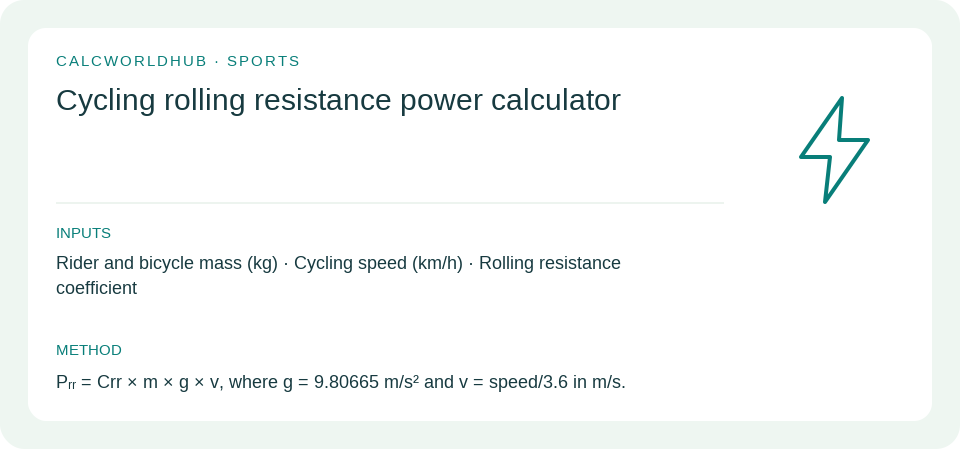
Estimate level-ground rolling-resistance power from combined mass, speed, and rolling-resistance coefficient.
- Enter Rider and bicycle mass (kg), Cycling speed (km/h), Rolling resistance coefficient. Match the units shown beside each field and review the result together with the assumptions below.
- Read the worked example below to check the expected input format and result.
- Compare another scenario by changing one input at a time. Use Reset to return to the starting values.
Estimate power used to overcome tire rolling resistance
For steady travel on a level surface, rolling-resistance force is approximated by Crr × total mass × gravity. Power is that force multiplied by ground speed.
Inputs and units
- Rider and bicycle mass (kg): Combined moving mass, including carried equipment if intended.
- Cycling speed (km/h): Nonnegative ground speed; it is converted to meters per second.
- Rolling resistance coefficient: Dimensionless coefficient for the tire-surface condition.
Formula and method
Pᵣᵣ = Crr × m × g × v, where g = 9.80665 m/s² and v = speed/3.6 in m/s.
Worked example
For 90 kg, 30 km/h (8.333 m/s), and Crr = 0.004, power ≈ 0.004×90×9.80665×8.333 = 29.42 W.
Interpreting the result
This isolates the rolling-resistance component. It rises linearly with speed, mass, and Crr.
Assumptions and limits
It excludes aerodynamic drag, climbing, acceleration, drivetrain loss, tire pressure effects, and wind. Gradient, air density, and CdA do not affect this rolling-only formula.
Method references
Frequently asked questions
Why were gradient and aerodynamic fields removed?
They describe climbing and air drag, not this rolling-resistance component.
Is this total rider power?
No. Add aerodynamic, gravitational, and drivetrain components for a broader estimate.
How do I use the Cycling rolling resistance power calculator?
Enter Rider and bicycle mass (kg), Cycling speed (km/h), Rolling resistance coefficient. Match the units shown beside each field and review the result together with the assumptions below.
What is a worked example of Cycling rolling resistance power?
For 90 kg, 30 km/h (8.333 m/s), and Crr = 0.004, power ≈ 0.004×90×9.80665×8.333 = 29.42 W.
What does the Cycling rolling resistance power calculator calculate?
Estimate level-ground rolling-resistance power from combined mass, speed, and rolling-resistance coefficient.
Good calculators show their work.
CalcWorldHub is built around clear inputs and visible assumptions. Results are estimates for planning; check official sources or your provider’s terms when exact figures matter.