Cycling steady-state power estimate calculator
Add climbing, rolling, and aerodynamic power components. Enter your values below for a free estimate, with no account required.
Calculator
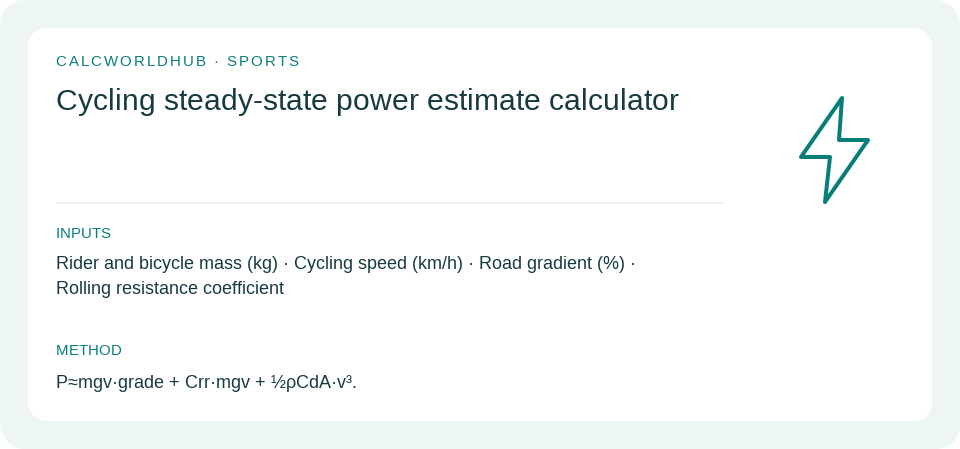
How to use this calculator
Sum climbing, rolling-resistance, and aerodynamic power at a steady speed. Convert speed from km/h to m/s and grade percent to a decimal.
- Enter Rider and bicycle mass (kg), Cycling speed (km/h), Road gradient (%), Rolling resistance coefficient, then complete the remaining labeled fields. Match the units shown beside each field and review the result together with the assumptions below.
- Read the worked example below to check the expected input format and result.
- Compare another scenario by changing one input at a time. Use Reset to return to the starting values.
Estimate steady cycling power on a constant grade
Sum climbing, rolling-resistance, and aerodynamic power at a steady speed. Convert speed from km/h to m/s and grade percent to a decimal.
Inputs and units
- Rider and bicycle mass (kg)
- Cycling speed (km/h)
- Road gradient (%)
- Rolling resistance coefficient
- Air density (kg/m³)
- Drag area CdA (m²)
Formula and method
P≈mgv·grade + Crr·mgv + ½ρCdA·v³.
Worked example
At 82 kg, 28 km/h, 5% grade, Crr=.004, ρ=1.225, and CdA=.32 m², the modeled total is about 430 W.
Interpreting the result
The component terms show why speed and uphill grade can strongly raise required power.
Assumptions and limits
Assumes steady speed, a small-angle grade approximation, no wind, and the stated air density and drag area. It excludes drivetrain losses and acceleration.
Method references
Frequently asked questions
Does this predict a race power target?
No. It estimates external steady-state demand from the selected physical assumptions.
How do I use the Cycling steady-state power estimate calculator?
Enter Rider and bicycle mass (kg), Cycling speed (km/h), Road gradient (%), Rolling resistance coefficient, then complete the remaining labeled fields. Match the units shown beside each field and review the result together with the assumptions below.
What is a worked example of Cycling steady-state power estimate?
At 82 kg, 28 km/h, 5% grade, Crr=.004, ρ=1.225, and CdA=.32 m², the modeled total is about 430 W.
What does the Cycling steady-state power estimate calculator calculate?
Sum climbing, rolling-resistance, and aerodynamic power at a steady speed. Convert speed from km/h to m/s and grade percent to a decimal.
What assumptions apply to Cycling steady-state power estimate?
Assumes steady speed, a small-angle grade approximation, no wind, and the stated air density and drag area. It excludes drivetrain losses and acceleration.
Good calculators show their work.
CalcWorldHub is built around clear inputs and visible assumptions. Results are estimates for planning; check official sources or your provider’s terms when exact figures matter.