How to use this calculator
Estimate deep-water wave power per metre of wave crest from significant wave height, energy period, and water density.
- Enter Significant wave height Hs (m), Energy period Te (s), Water density (kg/m³). Match the units shown beside each field and review the result together with the assumptions below.
- Read the worked example below to check the expected input format and result.
- Compare another scenario by changing one input at a time. Use Reset to return to the starting values.
How this calculation works
For a deep-water random sea state under linear wave theory, the average energy flux per unit wave-crest length depends on the square of significant wave height and the energy period. It represents incident resource, not electricity delivered by a converter.
Inputs and units
significantHeightM— Significant wave height Hs (m)- Spectral significant wave height in metres.
energyPeriodS— Energy period Te (s)- Wave energy period in seconds, consistent with the chosen sea-state spectrum.
waterDensityKgM3— Water density (kg/m³)- Bulk seawater density; pure-water or site-specific values may be entered.
Formula
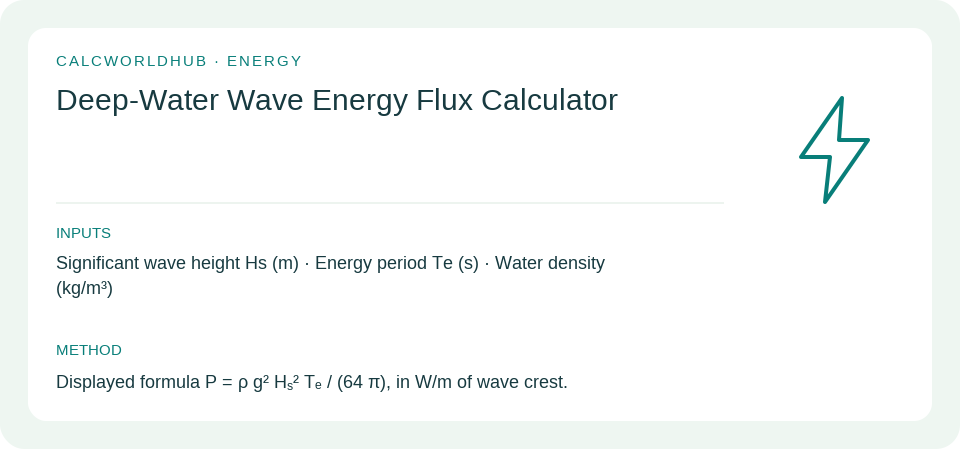
P = ρ g² Hₛ² Tₑ / (64 π), in W/m of wave crest.
Method
Enter significant wave height, energy period, and water density. The calculator evaluates deep-water energy flux per metre of crest and reports kilowatts per metre.
Worked example
For Hs = 2.0 m, Te = 8.0 s, seawater density 1,025 kg/m³, and standard gravity, the deep-water resource is about 15.69 kW/m of wave crest.
Assumptions and limits
The equation assumes deep water and linear wave theory. Use an energy period Tₑ, not automatically a peak or mean period. Finite-depth dispersion, directionality, nearshore transformation, device capture width, availability, and conversion efficiency are outside this estimate.
Frequently asked questions
What is energy period?
It is the spectral period used in the deep-water energy-flux expression; it may differ from peak or average period.
Does this estimate device output?
No. It estimates incident wave resource per metre of crest before capture, conversion, availability, and electrical losses.
When is the deep-water formula appropriate?
Use it when the wave conditions satisfy the deep-water assumption; nearshore finite-depth effects need a dispersion and group-velocity treatment.
How do I use the Deep-Water Wave Energy Flux Calculator?
Enter Significant wave height Hs (m), Energy period Te (s), Water density (kg/m³). Match the units shown beside each field and review the result together with the assumptions below.
What is a worked example of Deep-Water Wave Energy Flux?
For Hs = 2.0 m, Te = 8.0 s, seawater density 1,025 kg/m³, and standard gravity, the deep-water resource is about 15.69 kW/m of wave crest.
Reference: technical reference. See our calculation methodology.