How to use this calculator
Count regularly spaced emitters from an explicit first offset and estimate total nominal system flow.
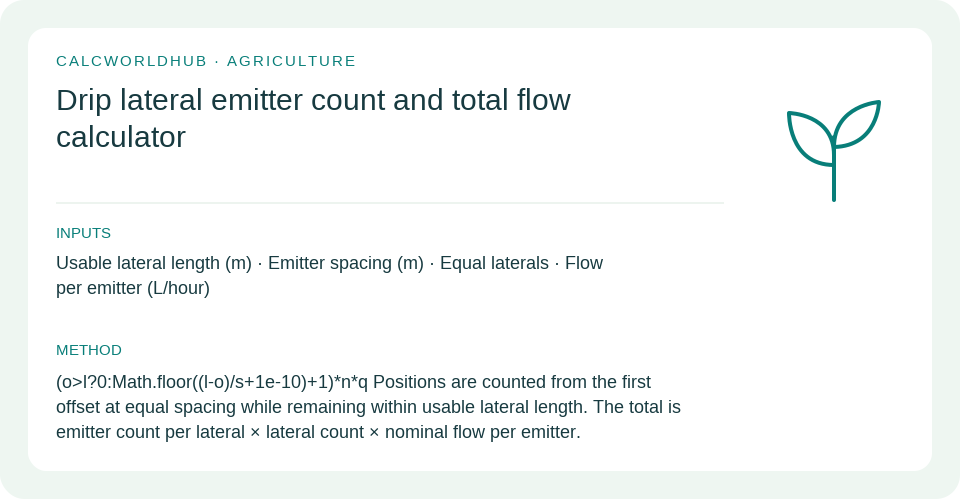
- Enter Usable lateral length (m), Emitter spacing (m), Equal laterals, Flow per emitter (L/hour), then complete the remaining labeled fields. Match the units shown beside each field and review the result together with the assumptions below.
- Read the worked example below to check the expected input format and result.
- Compare another scenario by changing one input at a time. Use Reset to return to the starting values.
Drip lateral emitter count and total flow explained
With 30 m laterals, 0.3 m spacing, and a 0.15 m end offset, 100 emitter positions fit each lateral. Ten laterals at 2 L/h per emitter deliver a nominal 2,000 L/h.
Inputs, symbols, and units
l— Usable lateral length (m)- Usable lateral length (m).
s— Emitter spacing (m)- Emitter spacing (m).
n— Equal laterals- Equal laterals. Enter a whole number.
q— Flow per emitter (L/hour)- Flow per emitter (L/hour).
o— First emitter offset from start (m)- First emitter offset from start (m).
Formula and method
(o>l?0:Math.floor((l-o)/s+1e-10)+1)*n*q
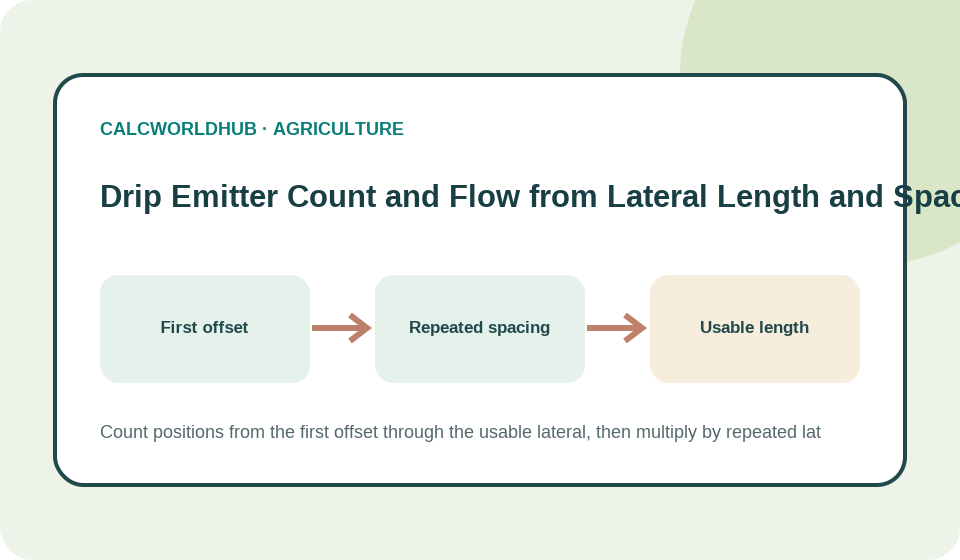
Positions are counted from the first offset at equal spacing while remaining within usable lateral length. The total is emitter count per lateral × lateral count × nominal flow per emitter.
A worked scenario
Usable lateral length (m) = 30; Emitter spacing (m) = 0.3; Equal laterals = 10; Flow per emitter (L/hour) = 2; First emitter offset from start (m) = 0.15.
- Nominal total emitter flow: 2000 L/hour
- Emitters per lateral: 100
- Total emitters: 1000
The count uses the 0.15 m first offset, so emitters do not sit at the lateral end; changing that offset can add or remove a position even when spacing is unchanged.
Assumptions and edge cases
Uniform emitter flow and identical lateral lengths; pressure losses, terrain, and clogging are excluded.
Frequently asked questions
Can an emitter lie exactly at the end?
Yes, endpoint positions are counted.
Why enter the first offset?
It determines the actual number of positions that fit.
Does this size a pump?
No, hydraulic head and pressure distribution are separate.
How do I use the Drip lateral emitter count and total flow calculator?
Enter Usable lateral length (m), Emitter spacing (m), Equal laterals, Flow per emitter (L/hour), then complete the remaining labeled fields. Match the units shown beside each field and review the result together with the assumptions below.
What is a worked example of Drip lateral emitter count and total flow?
Usable lateral length (m) = 30; Emitter spacing (m) = 0.3; Equal laterals = 10; Flow per emitter (L/hour) = 2; First emitter offset from start (m) = 0.15. Nominal total emitter flow: 2000 L/hour Emitters per lateral: 100 Total emitters: 1000 The count uses the 0.15 m first offset, so emitters do not sit at the lateral end; changing that offset can add or remove a position even when spacing is unchanged.
Read our calculation methodology.