How to use this calculator
Estimate nominal throat shear along straight weld segments under direct in-plane force and a centroidal moment.
- Enter Weld segment rows x1 y1 x2 y2 (mm), Effective throat thickness (mm), Direct group force x (N), Direct group force y (N), then complete the remaining labeled fields. Match the units shown beside each field and review the result together with the assumptions below.
- Read the worked example below to check the expected input format and result.
- Compare another scenario by changing one input at a time. Use Reset to return to the starting values.
Eccentric line weld group elastic shear explained
Use Weld segment rows x1 y1 x2 y2 (mm) with Effective throat thickness (mm) to reproduce the sample calculation, then review the stated limits before carrying the result into another scenario.
A numerical walkthrough
Weld segment rows x1 y1 x2 y2 (mm) = -50,-30,50,-30,-50,30,50,30; Effective throat thickness (mm) = 4; Direct group force x (N) = 3000; Direct group force y (N) = -9000; Moment about weld centroid (N m) = 500.
- Maximum nominal weld throat shear: 32.70255778 MPa
- Total weld length: 200 mm
- Weld group centroid x: 0 mm
- Weld group centroid y: 0 mm
- Polar second moment of throat area: 1386666.666667 mm^4
Two one-hundred-millimetre horizontal welds share direct force and a 500 N m centroidal moment. The effective throat thickness multiplies total weld length to form the nominal throat area.
The model behind the numbers
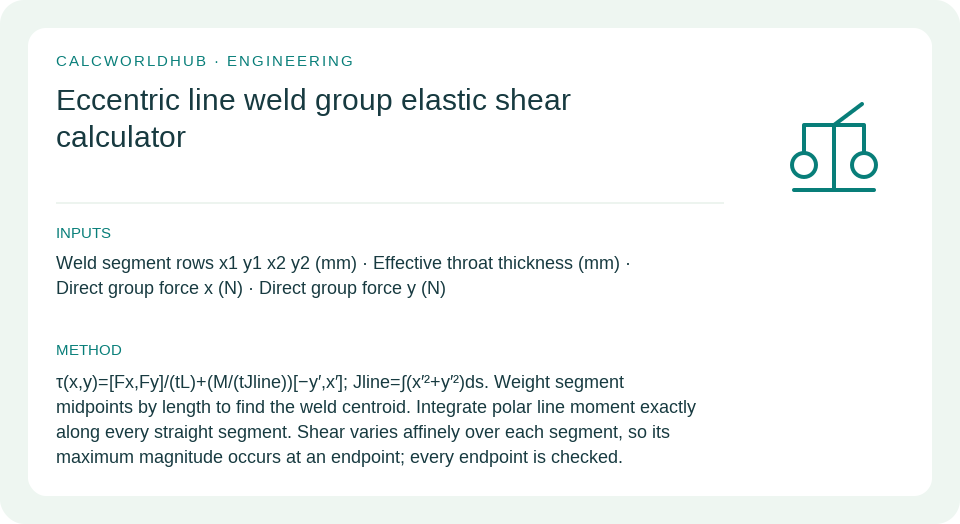
τ(x,y)=[Fx,Fy]/(tL)+(M/(tJline))[−y′,x′]; Jline=∫(x′²+y′²)ds.
Weight segment midpoints by length to find the weld centroid. Integrate polar line moment exactly along every straight segment. Shear varies affinely over each segment, so its maximum magnitude occurs at an endpoint; every endpoint is checked.
What to enter
s— Weld segment rows x1 y1 x2 y2 (mm)- Flatten rows x1,y1,x2,y2 for each straight weld segment. All coordinates are millimetres; exclude duplicated overlapping weld length. Use comma-separated values in the stated order.
t— Effective throat thickness (mm)- Effective throat thickness normal to the nominal weld throat. This is not automatically the visible fillet leg length.
Fx— Direct group force x (N)- Force in newtons.
Fy— Direct group force y (N)- Force in newtons.
M— Moment about weld centroid (N m)- Signed moment normal to the weld plane about its calculated centroid, in N m.
Interpreting the result
Uniform effective throat, elastic line-weld idealization, rigid connected parts, and in-plane loading. No weld code capacity, root stress, directional strength increase, plasticity, or out-of-plane bending is included.
Reading the outputs
The stress is a nominal vector magnitude in MPa. The throat input is not automatically the visible fillet leg size.
Frequently asked questions
Is t the fillet leg length?
No. Enter the effective throat appropriate to the actual weld geometry.
Can segments overlap?
Do not double-count an overlap as two independent weld lengths.
Does this cover out-of-plane bending?
No. The moment is normal to the plane of the weld group.
How do I use the Eccentric line weld group elastic shear calculator?
Enter Weld segment rows x1 y1 x2 y2 (mm), Effective throat thickness (mm), Direct group force x (N), Direct group force y (N), then complete the remaining labeled fields. Match the units shown beside each field and review the result together with the assumptions below.
What is a worked example of Eccentric line weld group elastic shear?
Weld segment rows x1 y1 x2 y2 (mm) = -50,-30,50,-30,-50,30,50,30; Effective throat thickness (mm) = 4; Direct group force x (N) = 3000; Direct group force y (N) = -9000; Moment about weld centroid (N m) = 500. Maximum nominal weld throat shear: 32.70255778 MPa Total weld length: 200 mm Weld group centroid x: 0 mm Weld group centroid y: 0 mm Polar second moment of throat area: 1386666.666667 mm^4 Two one-hundred-millimetre horizontal welds share direct force and a 500 N m centroidal moment. The effective throat thickness multiplies total weld length to form the nominal throat area.
Background or definition reference: MIT mechanics of materials background.
Read our calculation methodology.