Bearing pressure from load and contact area calculator
Calculate average compressive bearing pressure from a force distributed over a contact area. Enter your values below to see the result and method.
inputs.
Related calculators
These tools cover nearby questions while keeping this page focused on its own calculation.
How to use this calculator
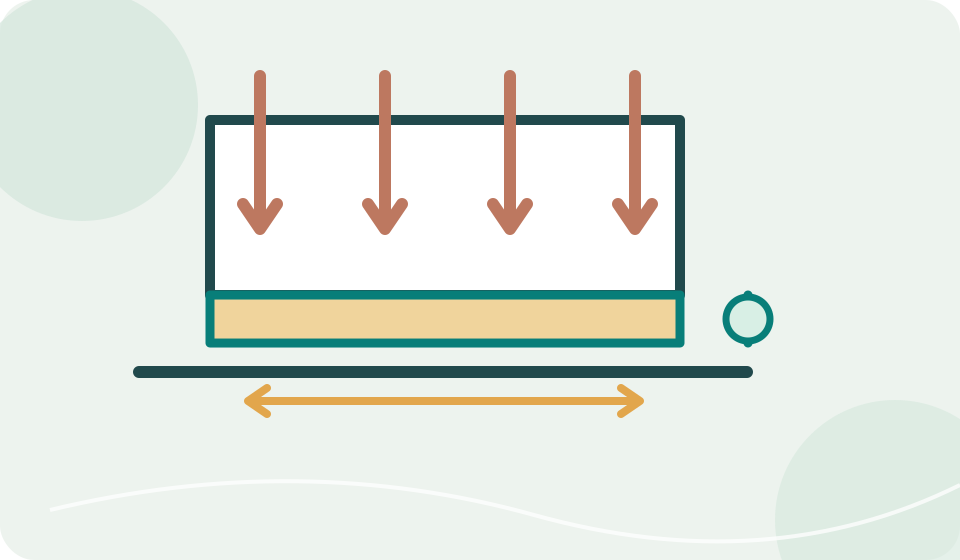
Divide the applied load by its contact area. Converting kN and mm² gives N/mm², numerically equal to MPa.
- Enter Applied load (kN), Contact area (mm²). Match the units shown beside each field and review the result together with the assumptions below.
- Read the worked example below to check the expected input format and result.
- Compare another scenario by changing one input at a time. Use Reset to return to the starting values.
Estimate average bearing pressure
Divide the applied load by its contact area. Converting kN and mm² gives N/mm², numerically equal to MPa.
Inputs and units
- Applied load (kN)
- Contact area (mm²)
Formula and method
p = F/A = load(kN) × 1000 ÷ area(mm²), reported in MPa.
Worked example
25 kN over 500 mm² gives 25,000/500 = 50 N/mm² = 50 MPa.
Interpreting the result
The number is the average compressive pressure over the entered area.
Assumptions and limits
Assumes uniform contact. It does not check local stress concentrations, deformation, allowable strength, or design-code requirements.
Method references
Frequently asked questions
Does 50 mean 50 kPa?
No. With these input units it means 50 MPa, equivalent to 50 N/mm².
How do I use the Bearing pressure from load and contact area calculator?
Enter Applied load (kN), Contact area (mm²). Match the units shown beside each field and review the result together with the assumptions below.
What is a worked example of Bearing pressure from load and contact area?
25 kN over 500 mm² gives 25,000/500 = 50 N/mm² = 50 MPa.
What does the Bearing pressure from load and contact area calculator calculate?
Divide the applied load by its contact area. Converting kN and mm² gives N/mm², numerically equal to MPa.
What assumptions apply to Bearing pressure from load and contact area?
Assumes uniform contact. It does not check local stress concentrations, deformation, allowable strength, or design-code requirements.