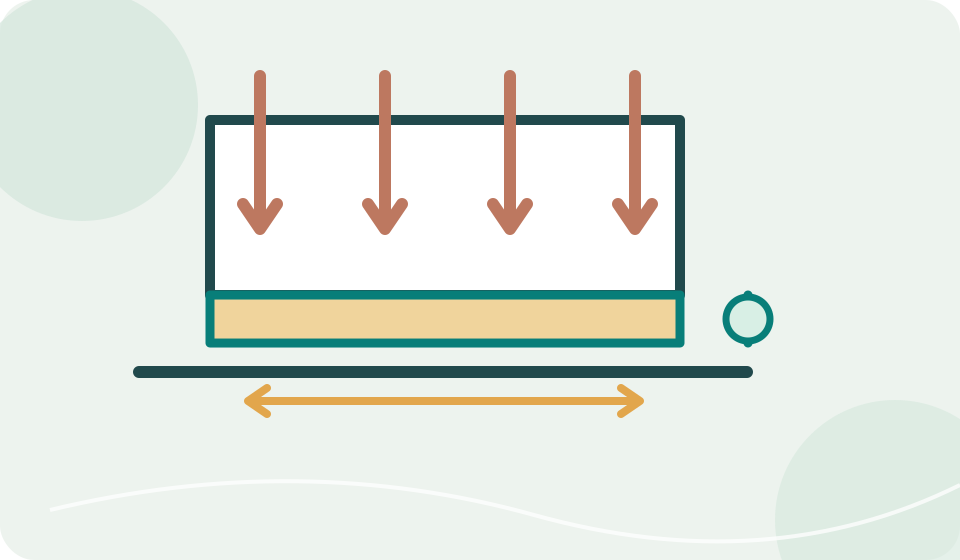

Average pressure versus local contact stress
Pressure is normal force divided by the area over which that force acts. In the calculator’s simplified contact model, the output is average compressive bearing pressure. It describes the mean load intensity if the entered force is distributed over the full entered area; it does not show how pressure varies from the center to an edge or around a fastener hole.
The actual contact footprint can differ from the visible face area. A stiff plate may bridge a gap, a curved component may touch over a narrower band, and a flexible surface can deform as the load increases. Partial or eccentric contact makes the full nominal area understate peak pressure. Determine the intended area from the geometry and contact condition, not from whichever dimensions are easiest to find.
Choose load and area inputs
Applied load is entered in kilonewtons and must be nonnegative. Contact area is entered in square millimetres and must be positive. The fields describe a force magnitude and a compressive contact patch; tension or a signed pressure state is outside this calculator’s contract. If several surfaces share the load, calculate the load on each surface and its own contact area rather than dividing one force by an unrelated total.
For a rectangular pad, area is length times width; for a circular flat face it is πd²/4. Use geometric area only where the surfaces actually touch and carry the load. For bolt bearing, projected bearing area is often thickness times bolt diameter, but the applicable design check may also require edge distance, tear-out, net section, and material resistance.
Formula and unit cancellation
The model is p̄ = F/A. Convert force first: 1 kN = 1,000 N. Then N/mm² is numerically equal to MPa, since 1 mm² is 10⁻⁶ m² and 1 N/mm² = 10⁶ N/m² = 1 MPa. Thus the displayed result is (load in kN × 1,000)/(area in mm²) MPa. The bar over p emphasizes that this is an average, not a local maximum.
For 25 kN over 500 mm², the force is 25,000 N and the quotient is 50 N/mm², or 50 MPa. If you divide 25 by 500 without converting kN to N, the numerical result is 0.05 and the unit is wrong by a factor of one thousand. A quick dimensional check—force per area—catches that mistake before comparing the value with any material data.
Two worked contact checks
For a second pad, let the compressive load be 18 kN and the effective area be 1,200 mm². The average is 18,000/1,200 = 15 N/mm² = 15 MPa. The lower pressure follows from the larger area and smaller load; it says nothing by itself about whether the pad, substrate, or fastener arrangement is adequate.
A useful sensitivity check holds the 25 kN load fixed. If the truly engaged area falls from 500 to 250 mm², the calculated average doubles from 50 to 100 MPa. If instead two identical patches share the load equally and each has the same area, each patch carries 12.5 kN and averages 25 MPa. Justify equal sharing from fit and stiffness, not the drawing alone.
What the average cannot establish
The result is not an allowable bearing stress, safety factor, or pass/fail decision. Capacity depends on the contacting materials, thickness, shape, surface condition, load duration, edge distance, confinement, and relevant design standard. A foundation check also distinguishes gross from net pressure and may be governed by settlement or shear failure rather than a simple local compressive limit.
Even when average pressure is modest, stress may peak at corners, edges, bolt holes, or small asperities. The idealized uniform distribution is most plausible for a flat, well-fitted, sufficiently stiff interface under centered loading, and it can still miss local deformation. Use contact analysis or the applicable tested/code method when details govern.
A practical verification checklist
Record the source and direction of the compressive load, identify the surface that actually transmits it, convert dimensions to a consistent area in mm², and confirm whether one or several interfaces share the force. Recompute F/A with newtons and square millimetres, then state the result in MPa. If a report uses kPa, remember that 1 MPa = 1,000 kPa.
When comparing two cases, change one factor at a time: at fixed force, doubling contact area halves average pressure; at fixed area, doubling force doubles it. If measured indentation disagrees, investigate contact and support rather than changing the arithmetic; this is not a contact solver.

Worked examples
Centered compressive pad
Inputs: Applied load = 25 kN; effective contact area = 500 mm².
Calculation: p̄ = 25×1,000/500 = 50 N/mm² = 50 MPa.
The average compressive bearing pressure is 50 MPa if the full area carries the load uniformly.
Larger contact area
Inputs: Applied load = 18 kN; effective contact area = 1,200 mm².
Calculation: p̄ = 18×1,000/1,200 = 15 N/mm² = 15 MPa.
The average is 15 MPa; local peaks and material capacity still need separate checks.