Safety factor calculator
Compare a stated capacity with the load applied to a component to see their simple ratio.
inputs.
Related calculators and articles
Compare methods and explore more free tools in engineering.
How to use this calculator
Calculate a simple factor of safety as rated capacity divided by applied load using matching force units.
- Complete the labeled inputs for Safety factor. Use the units requested by each field, then read the displayed result alongside the method and limits below.
- Read the worked example below to check the expected input format and result.
- Compare another scenario by changing one input at a time. Use Reset to return to the starting values.
A capacity-to-load ratio
Formula and method
Factor of safety = rated capacity ÷ applied load. A dimensionless result of 3 means the entered capacity is three times the entered load under this simple comparison.
Worked example
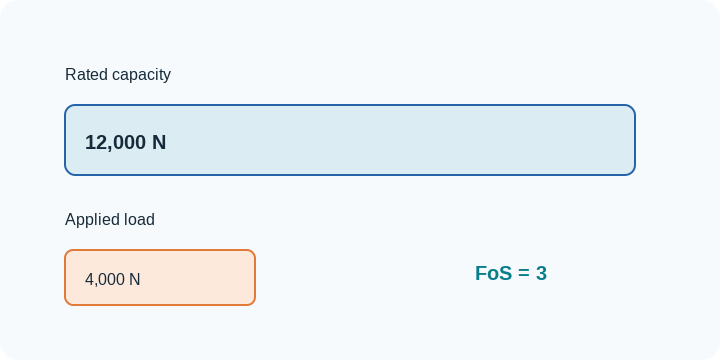
With rated capacity 12,000 N and applied load 4,000 N, 12,000 ÷ 4,000 = 3.0.
A second scenario
If the same 12,000 N capacity is compared with a 15,000 N applied load, the ratio is 0.8. In this simplified comparison, the entered load exceeds the entered capacity; it is not a design acceptance check.
Interpreting the result
A larger ratio indicates more separation between these two entered values. The result only compares the selected capacity and load for the stated failure mode.
Assumptions and limits
A ratio alone does not establish code compliance or safe design. Capacity basis, load combinations, fatigue, impact, material variability, environment, and required standards need review by a qualified engineer.
Sources and method notes
Read our calculation methodology.
Frequently asked questions
How do I use the Safety factor calculator?
Complete the labeled inputs for Safety factor. Use the units requested by each field, then read the displayed result alongside the method and limits below.
What is a worked example of Safety factor?
With rated capacity 12,000 N and applied load 4,000 N, 12,000 ÷ 4,000 = 3.0.
What does the Safety factor calculator calculate?
Calculate a simple factor of safety as rated capacity divided by applied load using matching force units.
What assumptions apply to Safety factor?
A ratio alone does not establish code compliance or safe design. Capacity basis, load combinations, fatigue, impact, material variability, environment, and required standards need review by a qualified engineer.
Which method does the Safety factor calculator use?
Factor of safety = rated capacity ÷ applied load. A dimensionless result of 3 means the entered capacity is three times the entered load under this simple comparison. The ratio compares the entered capacity with the entered load.