How to use this calculator
Estimate contact pressure and ideal axial friction capacity for a concentric elastic interference fit with a solid or hollow shaft.
- Enter Interface diameter (mm), Shaft bore diameter (mm), Hub outside diameter (mm), Contact length (mm), then complete the remaining labeled fields. Match the units shown beside each field and review the result together with the assumptions below.
- Read the worked example below to check the expected input format and result.
- Compare another scenario by changing one input at a time. Use Reset to return to the starting values.
Elastic hollow shaft hub interference fit explained
A numerical walkthrough
Interface diameter (mm) = 50; Shaft bore diameter (mm) = 20; Hub outside diameter (mm) = 90; Contact length (mm) = 40; Diametral interference (micrometres) = 30; Shaft Young modulus (MPa) = 210000; Hub Young modulus (MPa) = 70000; Shaft Poisson ratio = 0.3; Hub Poisson ratio = 0.33; Interface friction coefficient = 0.15.
- Elastic interference contact pressure: 16.25906354 MPa
- Hub inner-wall hoop stress: 30.77608455 MPa
- Ideal axial friction capacity: 15323.806369 N
- Radial interference: 0.015 mm
Thirty micrometres of diametral interference becomes fifteen micrometres radially. The aluminum-like hub is more compliant than the steel-like hollow shaft in this example.
The model behind the numbers
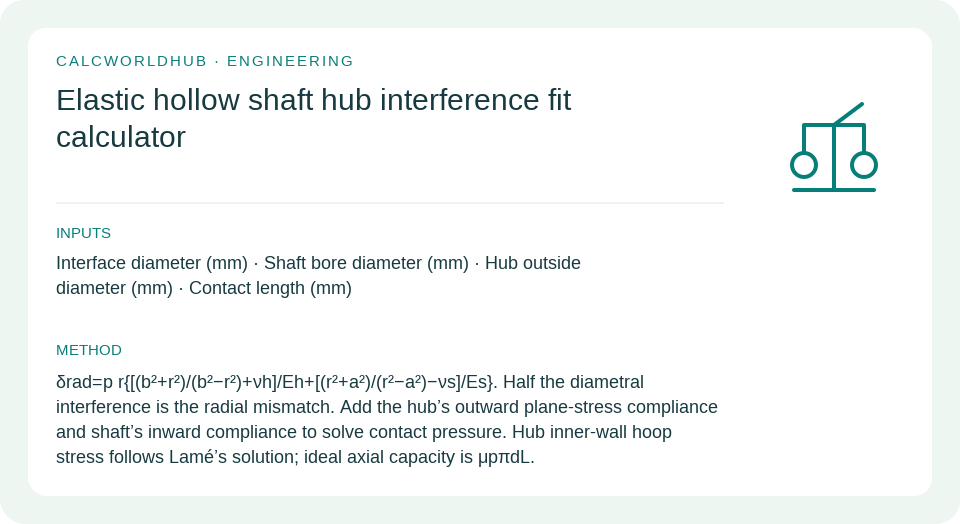
δrad=p r{[(b²+r²)/(b²−r²)+νh]/Eh+[(r²+a²)/(r²−a²)−νs]/Es}.
Half the diametral interference is the radial mismatch. Add the hub’s outward plane-stress compliance and shaft’s inward compliance to solve contact pressure. Hub inner-wall hoop stress follows Lamé’s solution; ideal axial capacity is μpπdL.
What to enter
d— Interface diameter (mm)- Length in millimetres.
di— Shaft bore diameter (mm)- Internal shaft bore diameter. Zero specifies a solid shaft; it must stay below interface diameter d.
D— Hub outside diameter (mm)- Length in millimetres.
L— Contact length (mm)- Length in millimetres.
delta— Diametral interference (micrometres)- Difference between shaft and hub diameters before assembly, in micrometres. The radial compliance calculation uses half this mismatch.
Es— Shaft Young modulus (MPa)- Stress or elastic modulus in megapascals; one MPa equals one N/mm².
Eh— Hub Young modulus (MPa)- Stress or elastic modulus in megapascals; one MPa equals one N/mm².
nus— Shaft Poisson ratio- Shaft Poisson ratio. This is a dimensionless model parameter unless the label explicitly states a unit.
nuh— Hub Poisson ratio- Hub Poisson ratio. This is a dimensionless model parameter unless the label explicitly states a unit.
mu— Interface friction coefficient- Assumed uniform static friction coefficient for the nominal axial capacity calculation; it does not affect the elastic contact pressure.
Interpreting the result
Concentric cylindrical elastic parts, uniform contact pressure, plane-stress radial compliance, and no roughness loss. No tolerance stack, plastic fit, temperature effect, fretting, or installation-force model is included.
Reading the outputs
Friction capacity assumes the entered coefficient applies uniformly over the full contact area. It is a nominal model output, not an installation or service approval.
Frequently asked questions
Can the shaft be solid?
Yes. Set bore diameter to zero.
Is interference radial or diametral?
The input is diametral; the model divides it by two.
Does this calculate thermal assembly temperature?
No. Thermal expansion and assembly conditions are separate.
How do I use the Elastic hollow shaft hub interference fit calculator?
Enter Interface diameter (mm), Shaft bore diameter (mm), Hub outside diameter (mm), Contact length (mm), then complete the remaining labeled fields. Match the units shown beside each field and review the result together with the assumptions below.
What is a worked example of Elastic hollow shaft hub interference fit?
Interface diameter (mm) = 50; Shaft bore diameter (mm) = 20; Hub outside diameter (mm) = 90; Contact length (mm) = 40; Diametral interference (micrometres) = 30; Shaft Young modulus (MPa) = 210000; Hub Young modulus (MPa) = 70000; Shaft Poisson ratio = 0.3; Hub Poisson ratio = 0.33; Interface friction coefficient = 0.15. Elastic interference contact pressure: 16.25906354 MPa Hub inner-wall hoop stress: 30.77608455 MPa Ideal axial friction capacity: 15323.806369 N Radial interference: 0.015 mm Thirty micrometres of diametral interference becomes fifteen micrometres radially. The aluminum-like hub is more compliant than the steel-like hollow shaft in this example.
Background or definition reference: MIT OCW, Pressure Vessels (compound-cylinder contact pressure and interference fit).
Read our calculation methodology.