How to use this calculator
Estimate the bill component charged for peak electrical demand during a billing period.
- Enter Billed peak demand (kW), Demand rate ($/kW). Match the units shown beside each field and review the result together with the assumptions below.
- Read the worked example below to check the expected input format and result.
- Compare another scenario by changing one input at a time. Use Reset to return to the starting values.
How this calculation works
Some commercial tariffs bill both energy consumed and the highest demand measured in a billing interval. This tool isolates the demand component so it is not confused with a kWh energy charge.
Inputs and units
peak— Billed peak demand (kW)- Use the utility-billed peak for this period.
rate— Demand rate ($/kW)- Rate for the matching billing period.
Formula
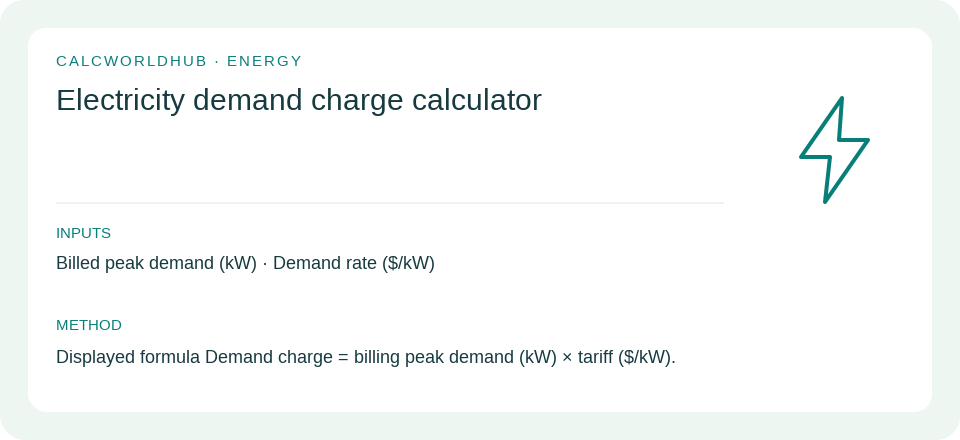
Demand charge = billing peak demand (kW) × tariff ($/kW).
Worked example
A 120 kW billed peak at $18.50/kW produces a $2,220 demand charge.
Assumptions and limits
Does not calculate energy charges, taxes, demand ratchets, power-factor penalties, or time-of-use rules.
Frequently asked questions
Is this the full electricity bill?
No. Energy, fixed fees, taxes, and other tariff items are excluded.
Should I enter average kW?
Use the billed peak demand, not average energy use.
Can a prior peak affect this period?
Some tariffs use demand ratchets; use the billed kW shown by the utility if that rule applies.
How do I use the Electricity demand charge calculator?
Enter Billed peak demand (kW), Demand rate ($/kW). Match the units shown beside each field and review the result together with the assumptions below.
What is a worked example of Electricity demand charge?
A 120 kW billed peak at $18.50/kW produces a $2,220 demand charge.
Read our calculation methodology.