How to use this calculator
Measure the share of delivered outreach emails that received a reply within a defined window.
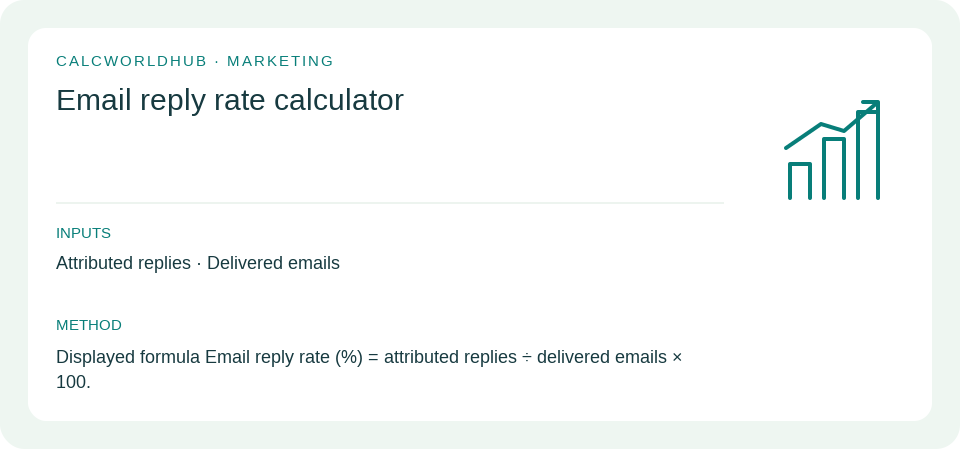
- Enter Attributed replies, Delivered emails. Match the units shown beside each field and review the result together with the assumptions below.
- Read the worked example below to check the expected input format and result.
- Compare another scenario by changing one input at a time. Use Reset to return to the starting values.
How this calculation works
Reply rate is useful for evaluating outbound email engagement when the sent cohort and reply-attribution window are defined consistently. Use delivered messages as the denominator so bounced messages are not counted as opportunities to reply.
Inputs and units
replies— Attributed replies- Replies credited to the chosen email send and response window.
delivered— Delivered emails- Messages delivered in the same send cohort.
Formula
Email reply rate (%) = attributed replies ÷ delivered emails × 100.
Worked example
With 96 attributed replies from 1,200 delivered emails, reply rate is 96 ÷ 1,200 × 100 = 8%.
Assumptions and limits
Automated replies, out-of-office messages, threaded replies, and duplicate recipients can change the count. This does not measure qualified responses, meetings, or sales.
Frequently asked questions
Are automatic replies included?
Decide whether to exclude out-of-office and automated responses, then apply the same rule to every campaign.
Should the denominator be sent or delivered?
This calculator uses delivered emails; sent messages that bounced are excluded.
Does a reply count mean a qualified lead?
No. It counts attributed replies, not their relevance or downstream business value.
How do I use the Email reply rate calculator?
Enter Attributed replies, Delivered emails. Match the units shown beside each field and review the result together with the assumptions below.
What is a worked example of Email reply rate?
With 96 attributed replies from 1,200 delivered emails, reply rate is 96 ÷ 1,200 × 100 = 8%.
Read our calculation methodology.