How to use this calculator
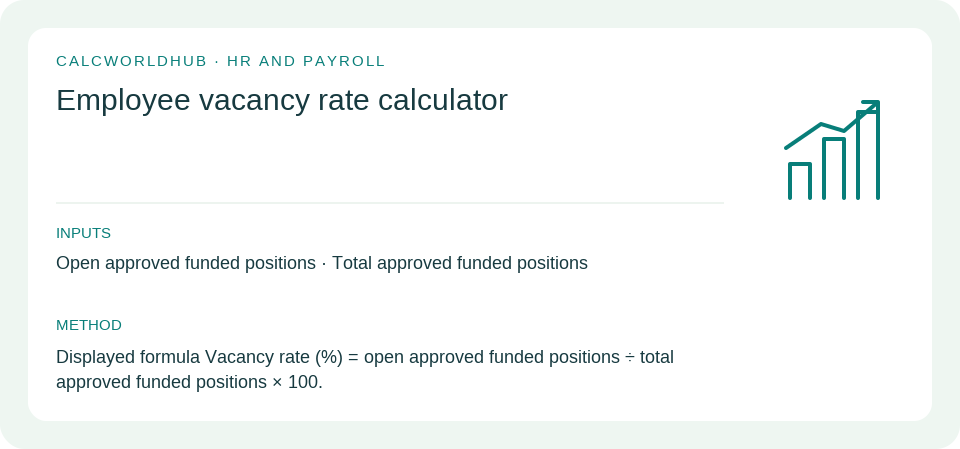
Calculate the share of approved funded positions that are currently vacant.
- Enter Open approved funded positions, Total approved funded positions. Match the units shown beside each field and review the result together with the assumptions below.
- Read the worked example below to check the expected input format and result.
- Compare another scenario by changing one input at a time. Use Reset to return to the starting values.
How this calculation works
An employee vacancy rate is a point-in-time staffing measure. Count open positions that remain approved and funded, then divide by the total approved funded positions in the same organizational scope.
Inputs and units
vacant— Open approved funded positions- Count unfilled positions included in the staffing snapshot.
authorized— Total approved funded positions- Filled plus vacant positions in the same scope and snapshot.
Formula
Vacancy rate (%) = open approved funded positions ÷ total approved funded positions × 100.
Method
The numerator is a subset of the denominator. Use a consistent snapshot date and include only positions your organization treats as funded and in scope.
Worked example
Eight open positions out of 80 approved funded positions gives 8 ÷ 80 × 100 = 10%.
Assumptions and limits
This percentage does not measure how long roles have been vacant, recruiting difficulty, or labor demand. Frozen, newly authorized, contingent, and temporarily covered roles need a consistent inclusion policy.
Frequently asked questions
Do frozen positions count as vacant?
Only if your organization still treats them as approved funded positions; define the scope before comparing snapshots.
Is vacancy rate the same as turnover?
No. Vacancy rate is the current share of positions unfilled; turnover counts separations over a period.
Does this show how long vacancies remain open?
No. Pair it with time-to-fill or vacancy-age reporting for duration.
How do I use the Employee vacancy rate calculator?
Enter Open approved funded positions, Total approved funded positions. Match the units shown beside each field and review the result together with the assumptions below.
What is a worked example of Employee vacancy rate?
Eight open positions out of 80 approved funded positions gives 8 ÷ 80 × 100 = 10%.
Read our calculation methodology.