How to use this calculator
Estimate the maximum value of perfect information by comparing the best expected payoff with and without known outcomes.
- Enter State-of-nature probabilities (%) in order, Number of decision options, Option payoffs in row order. Match the units shown beside each field and review the result together with the assumptions below.
- Read the worked example below to check the expected input format and result.
- Compare another scenario by changing one input at a time. Use Reset to return to the starting values.
How this calculation works
Enter the probability of each mutually exclusive outcome and a payoff for every decision option under every outcome. The calculator first finds the best expected payoff when one option must be chosen before the outcome is known. It then assumes the outcome is known in advance and selects the best option separately for each outcome.
Inputs and units
stateProbabilities— State-of-nature probabilities (%) in order- Enter 2–8 percentages separated by commas, in the same state order used for every option. They must total 100%.
optionCount— Number of decision options- Enter 2–8 options. Payoff values below are grouped into this many rows.
payoffValues— Option payoffs in row order- Enter option 1 payoffs across all states, then option 2, and so on. Separate values with commas. Use the same payoff unit throughout.
Formula
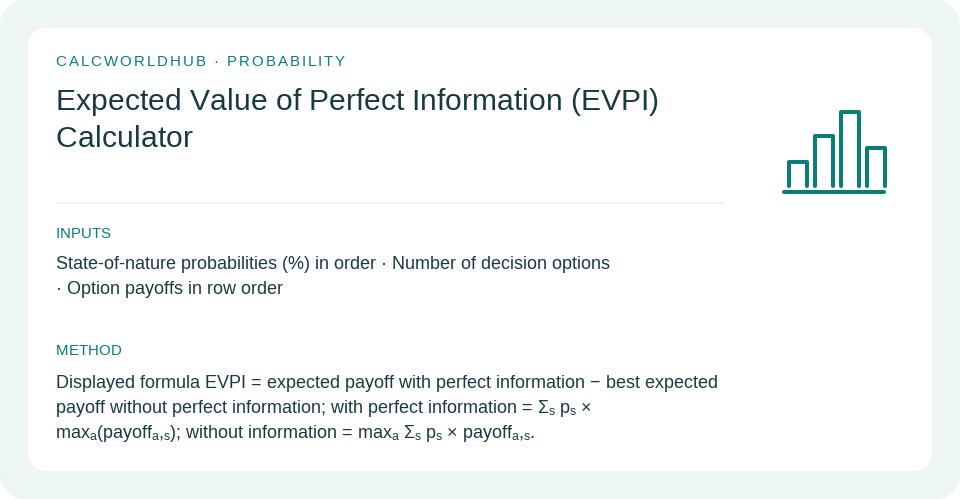
EVPI = expected payoff with perfect information − best expected payoff without perfect information; with perfect information = Σₛ pₛ × maxₐ(payoffₐ,ₛ); without information = maxₐ Σₛ pₛ × payoffₐ,ₛ.
Method
Treat each payoff row as one decision option and each probability as one possible state of nature in the same order. Divide each percentage by 100. For each option, calculate its probability-weighted payoff and select the largest. For perfect information, select the largest payoff within each state, weight those maxima by their state probabilities, and subtract the best no-information expected payoff.
Worked example
With state probabilities 40%, 35%, and 25%, and payoff rows (80, 20, 0), (50, 60, 10), and (0, 40, 100), the best payoff without information is 43.5, the expected payoff with perfect information is 78, and EVPI is 34.5 payoff units.
Assumptions and limits
This calculation assumes a risk-neutral decision-maker who maximizes expected payoff and that the listed states are mutually exclusive and exhaustive. EVPI is a theoretical upper bound on the value of imperfect research or information, before its cost; it is not the predicted value of a real study. For a cost-minimization problem, enter negative costs so the preferred payoff remains the larger value.
Frequently asked questions
What does EVPI mean?
It is the most a risk-neutral decision-maker could gain from knowing the future state before choosing an option, under the entered payoff model. It is an upper bound for imperfect information.
Why can EVPI be zero?
If the same option is already best in every state, knowing the state does not change the decision and cannot improve expected payoff.
How should I enter the payoff table?
Enter probabilities in state order. Then enter each option’s payoff across those states, with option rows one after another. For 3 states and 3 options, enter 9 payoff values.
Can I use costs instead of benefits?
Yes. Enter each cost as a negative payoff, so the least costly option has the largest payoff. Use one consistent currency or other payoff unit.
How do I use the Expected Value of Perfect Information (EVPI) Calculator?
Enter State-of-nature probabilities (%) in order, Number of decision options, Option payoffs in row order. Match the units shown beside each field and review the result together with the assumptions below.
Reference: University of London Managerial Economics study guide, section on expected value of perfect information. See our calculation methodology.