How to use this calculator
Calculate the exponential cumulative probability that an event occurs by time t for a constant rate λ.
- Complete the labeled inputs for Exponential distribution CDF. Use the units requested by each field, then read the displayed result alongside the method and limits below.
- Read the worked example below to check the expected input format and result.
- Compare another scenario by changing one input at a time. Use Reset to return to the starting values.
Probability accumulated by time t
Formula and method
For event rate λ and elapsed time t in matching units, F(t) = P(T ≤ t) = 1 − e^(−λt). The product λt is dimensionless; the rate must be positive and time cannot be negative.
Worked example
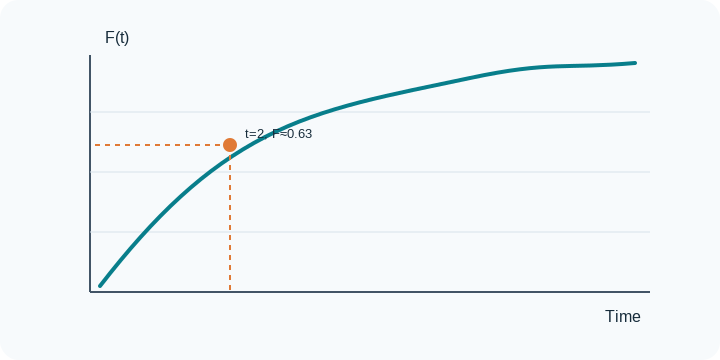
At λ=0.5 per time unit and t=2 time units, F(t)=1−e^(−1)≈0.6321. The model assigns about a 63.21% probability to an event by time two.
Interpreting the result
The remaining 54.88% is the survival probability beyond five months. The two values complement one another to 1, apart from display rounding.
Assumptions and limits
Use this distribution when a constant hazard is defensible. Aging, wear-out, recovery, changing exposure, and competing event types can produce a different time-to-event pattern.
Sources and method notes
Read our calculation methodology.
Frequently asked questions
How do I use the Exponential distribution CDF calculator?
Complete the labeled inputs for Exponential distribution CDF. Use the units requested by each field, then read the displayed result alongside the method and limits below.
What is a worked example of Exponential distribution CDF?
At λ=0.5 per time unit and t=2 time units, F(t)=1−e^(−1)≈0.6321. The model assigns about a 63.21% probability to an event by time two.
What does the Exponential distribution CDF calculator calculate?
Calculate the exponential cumulative probability that an event occurs by time t for a constant rate λ.
What assumptions apply to Exponential distribution CDF?
Use this distribution when a constant hazard is defensible. Aging, wear-out, recovery, changing exposure, and competing event types can produce a different time-to-event pattern.
Which method does the Exponential distribution CDF calculator use?
For event rate λ and elapsed time t in matching units, F(t) = P(T ≤ t) = 1 − e^(−λt). The product λt is dimensionless; the rate must be positive and time cannot be negative. The CDF is one minus the survival probability.